

Most distractions do not begin with a notification. They begin with a slight moment of discomfort.
A sentence becomes difficult to write. A decision feels uncertain. An email comes to mind. You tell yourself you will check it for only a minute. Then you open a message, reply to something else, notice another task, and return twenty minutes later with the strange feeling that you have been busy without moving.
The problem is not always a lack of discipline.
Often, it is that you left your work without giving your mind a way back.
Focus Does Not Disappear at Once
We imagine focus as something we either have or do not have. But attention usually breaks into smaller pieces.
You are writing a report. A message appears. You answer it. Then you return to the report, but part of your mind is still inside the conversation you just left. You remember a question you did not answer. You wonder whether a reply is coming. You reread the last paragraph of the report because you no longer remember what you were trying to say.
Psychologist Sophie Leroy calls this attention residue.
When we move from one task to another—especially before the first task feels complete, part of our attention can remain attached to what we left behind. In Leroy’s research, people performed worse on the next task when their attention had not fully disengaged from the unfinished one. Leroy’s study on attention restudies.
This is why multitasking can feel productive while quietly making work slower. We are not really doing several demanding things at once. We are switching between them, and each switch asks the mind to reload its place, its goal, and its next move. Research summarized by the American Psychological Association finds that task switching carries measurable time and error costs, particularly as tasks become more complex or unfamiliar.
The Rule: Leave a Return Line
Before you switch tasks, write one sentence that tells you exactly what to do when you come back.
Call it a return line.
It can be as simple as:
“Next: find the customer’s March invoice and compare it with the payment record.”
Or:
“Next: write the example that explains why the first sentence matters.”
Or:
“Next: call James and ask whether the meeting can move from Thursday to Friday.”
The sentence does not need to solve the whole task. It only needs to remove the question that usually slows you down:
Where was I?
That is the rule:
Before you leave a task, write down the next visible action.
Not the project. Not a vague reminder. The next action.
“Work on the article” is not a return line.
“Write the paragraph explaining attention residue” is.
“Deal with finances” is not a return line.
“Open the budget sheet and categorize last week’s expenses” is.
A return line gives unfinished work a place to wait. It lowers the chance that the task will keep following you into the next conversation, the next meeting, or the next hour.
Why It Helps
The mind dislikes open loops.
An unfinished task keeps calling for attention because it carries uncertainty: what needs to happen, when should it happen, and how will you remember it? A return line answers all three questions in one place.
You are not trying to force yourself never to be interrupted. That is not realistic. Calls arrive. Meetings begin. Children need something. A colleague needs an answer. Life interrupts.
The goal is simpler: when you must leave, leave a trail back.
That trail protects the version of you who returns later—tired, distracted, and unable to remember why the task mattered five minutes ago.
The One Thing to Do Today
Choose one task that requires real concentration.
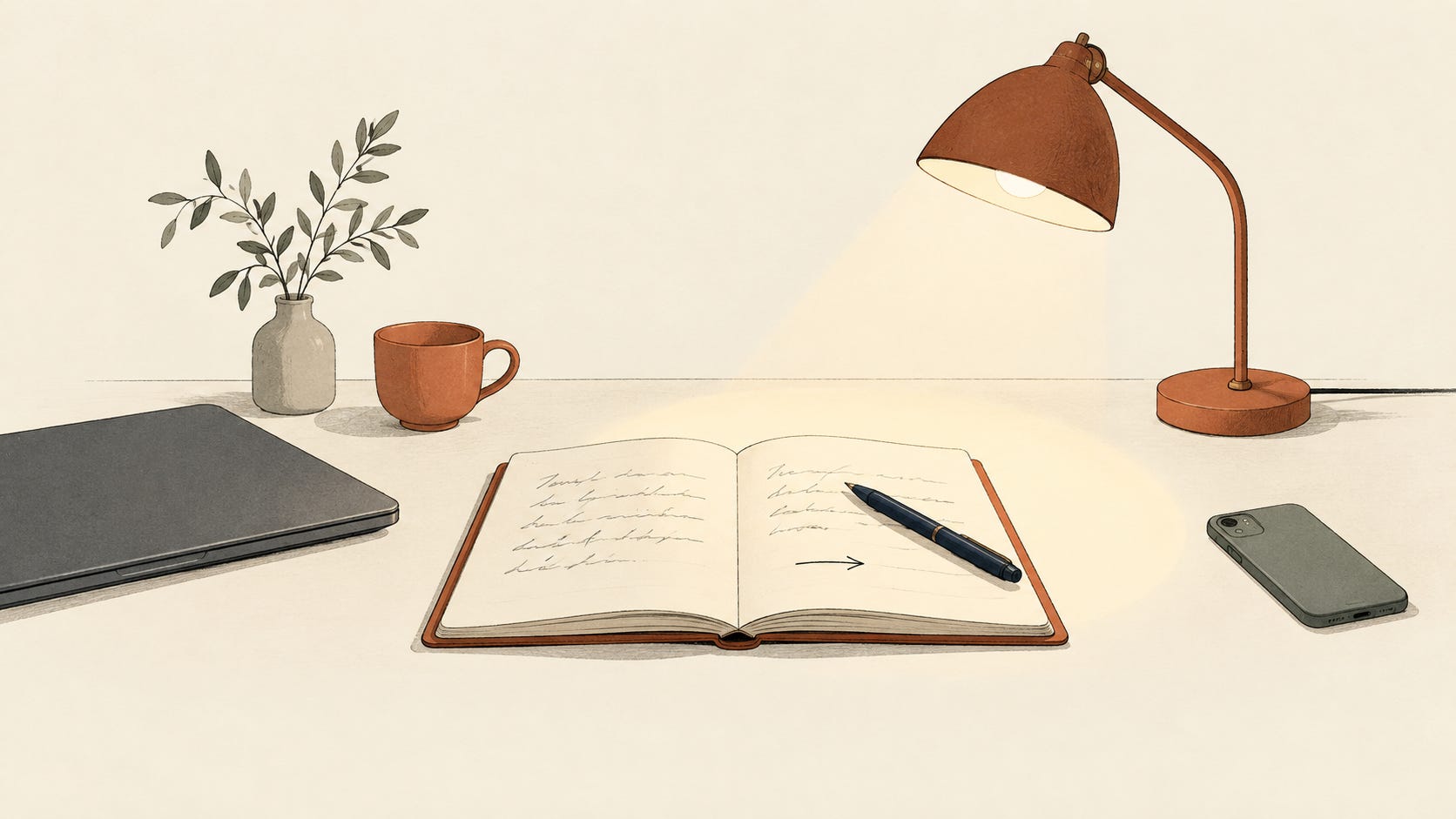
Before you begin, put a notebook beside you or open a blank note titled Return Lines.
Every time you need to switch away from the task, pause for ten seconds and write:
“Next: .”
Be specific.
Do this before you open the email. Do it before a meeting. Do it before you answer a message. Do it even if you believe you will remember.
Look at the lines you wrote. You may notice something useful: many interruptions are unavoidable, but much of the confusion after an interruption is optional.
The return line is small. Its effect is not dramatic in the moment.
But it prevents each switch from becoming a restart.
A Better Way to Work
Focus is not protected by waiting for a perfect, silent day.
It is protected by making your work easy to re-enter.
When you leave a task without a return line, you make tomorrow’s version of yourself reconstruct the past. When you leave one clear next step, you make returning almost fiction - free.
That is how focus becomes more durable.
Not by demanding that your attention never wander.
By making it easier to come back.
Related Reading
The Habit That Makes Tomorrow Easier — how a five-minute list at night can help you begin the next day with your first move already chosen.
The Discipline Behind Every Identity You Admire — why identity is built through the small actions you repeat.
Go Deeper with Membership
If this essay helped you think more clearly about focus, membership gives you the deeper work behind it.
Read the complete quarterly issue, explore the archive, and support research-backed writing on habits, identity, discipline, and deliberate living.
Reply and tell me: What task do you most often leave without a simple way back?
See you next time,
Pierre Poteau
Borgella Street Journal
Reference
Leroy, Sophie. “Why Is It So Hard to Do My Work? The Challenge of Attention Residue When Switching Between Work Tasks.” Organizational Behavior and Human Decision Processes, vol. 109, no. 2, 2009, pp. 168–181.