

Ulysses did not trust himself to resist the sirens, so he never gave himself the chance to try. The research behind that move, called pre-commitment, holds up better than almost anything else in the discipline literature. Here is how to use it on yourself.

A colleague of mine spent eleven months promising herself she would finally write the book proposal she had been circling for two years. Every Sunday she planned the week that would finally hold the time for it. Every Friday the week had somehow filled itself with everything except that. She did not lack the idea, nor did not lack the ability. She lacked a wall between herself on Sunday, who wanted the proposal to exist, and herself on Wednesday at four in the afternoon, who did not feel like starting something hard with two hours left in the day.
She described the Wednesday version of herself almost as a separate person, someone who showed up with the same face and the same calendar but none of the conviction the Sunday version had felt so certain about. This is a common enough experience that it deserves a better explanation than simply calling Wednesday afternoon her a weaker person. The explanation that actually holds up in the research has nothing to do with weakness at all.
The old story about discipline says she needed more willpower, deployed more consistently, Wednesday after Wednesday, until the habit finally stuck. The more useful story, and the one with sturdier research behind it, says she needed something closer to a wall, a structure built in advance that made the Wednesday version of herself irrelevant to whether the work happened at all.
I. The Mast and the Sirens
In the Odyssey, Ulysses wants to hear the sirens sing without steering his ship onto the rocks they lure sailors toward. He does not trust his future self to resist the sound once he hears it, so he does something more honest than promising his crew he will stay strong. He has them bind him to the mast before the ship gets close enough to hear anything, and he orders them to ignore whatever he begs once the singing starts. He does not fight the temptation the moment it arrives. He removes his own ability to act on it, using a decision made while he was still thinking clearly.
What makes the story useful is not the drama but the timing. Ulysses does not wait until the sirens are audible to decide how he will handle them. He makes the binding decision earlier, on calm water, when the pull of the song is still theoretical rather than immediate. All pre-commitment strategies discussed here use the same timing rule: decide before temptation, execute automatically when it appears, no new vote needed then.
Ulysses did not trust himself to resist the Sirens. He trusted himself to build the mast.
This piece examines pre-commitment, a behavioral research strategy, and argues that the evidence for its effectiveness significantly outweighs the evidence for the alternative strategy of increasing one’s desire for something in moments of difficulty. Researchers found this pattern in preschools, college classes, payroll systems, and in extended goal achievement. When the same basic mechanism keeps surfacing across settings that share almost nothing else in common, it is usually pointing at something real rather than something that worked once in a single famous study.
II. Why the Fight Rarely Survives the Evening.
Roy Baumeister’s original research on what he called ego depletion proposed that self-control draws from a limited resource that runs low over the course of a day. The specific mechanism has faced serious challenges from large replication efforts over the past decade, and readers who followed that debate closely know the picture is more contested than the popular version admits. What survives the debate on sturdier ground is simpler and better supported. A comprehensive meta-analysis of sleep and self-control spanning sixty-one independent studies found consistent links between sleep quality and duration and how well people regulate impulses, both across individuals and within the same person from one night to the next. Fatigue erodes follow-through, and the evidence for that points most reliably at sleep and accumulated decisions rather than any single abstract willpower reserve.
This distinction is not just academic housekeeping. It changes where a person should actually intervene. If the abstract willpower reserve theory were the entire story, the fix would be vague, something like trying harder or resting between hard tasks throughout the day. Prioritize sleep before big decisions and minimize smaller choices beforehand.
The practical implication holds regardless of which exact mechanism turns out to be correct. Decisions made late in the day, after many prior choices, are less likely to succeed than those made early or pre-approved. My colleague’s Wednesday afternoons were never a fair fight. She was asking her most depleted self to generate motivation her most rested self had never banked in advance.
III. Mischel’s Real Lesson: Remove the Choice, Do Not Fight It
People remember Walter Mischel’s marshmallow studies for the wrong reason. The headline correlation between waiting as a preschooler and later outcomes has not held up nearly as well under later, more diverse replication as the original reporting suggested. What has held up is the mechanism inside the room. Children who waited successfully were not staring down the marshmallow through sheer force of will. They looked away, sang to themselves, or mentally reframed the object as a picture rather than something real and edible sitting in front of them. When researchers later taught children these specific attention strategies directly, wait times improved, evidence that the mechanism transfers through teaching rather than requiring some innate reserve of patience a child either has or does not have .
That mechanism is pre-commitment in miniature. A child who turns his chair away from the marshmallow has not out willed the temptation. He has removed his own access to the moment of choice, the same move Ulysses made with the mast, just scaled down to a preschool classroom. The adult version looks almost identical. Removing the app instead of promising not to open it, leaving a wallet at home instead of promising not to spend, canceling a subscription instead of promising to watch less, all function the same way. None of them ask the tired, tempted version of you to win a fight. They simply make sure that version of you never gets the chance to enter the fight at all.
The distinction between fighting and removing sounds subtle until it gets tested against actual behavior. Fighting a temptation requires sustained attention on the very thing pulling you off course, which keeps the pull vivid the entire time you are supposedly resisting it. Removing the temptation from view or from reach requires one decision, made once, after which there is nothing left to resist because there is nothing left in front of you. The second approach asks far less of the person and, according to the research that has actually survived scrutiny, delivers considerably more reliable results.
IV. The Deadline Experiment
In 2002, researchers Dan Ariely and Klaus Wertenbroch tested pre-commitment directly through a series of deadline experiments rather than inferring it from a marshmallow. In the first part of the study, one group of students had three papers due only at the end of the semester, giving them complete freedom to set their own private deadlines however they liked. A second group had evenly spaced deadlines imposed on them externally throughout the term, with no room for negotiation. The question was whether students who set their own binding deadlines would do so at all, and whether doing so actually improved their performance compared with total freedom.
Students set their own deadlines throughout the term, avoiding cramming all three papers into the last week. They understood their own future unreliability well enough to build a wall against it voluntarily, with no one requiring them to. The self-imposed deadlines improved their performance meaningfully compared to having no deadlines at all, though not quite as well as deadlines imposed by an outside authority with genuinely no room for negotiation.

A pre-commitment does not ask for more willpower. It asks for one decision made early enough to bind the version of you who shows up later.
The gap between self-imposed and externally imposed deadlines matters, and a second part of the same study helps explain why. When the researchers randomly assigned deadlines to a separate group of participants rather than letting them choose their own spacing, those externally assigned deadlines produced the strongest results of all, better than even the best self-chosen schedules. This suggests pre-commitment works best when it removes real flexibility rather than merely announcing an intention. A deadline you can quietly renegotiate with yourself at the first sign of resistance is not really a wall. It is a suggestion wearing a wall’s clothing, and the version of you under deadline pressure will find the seam every time. The lesson for building your own pre-commitment device is to borrow as much of that external rigidity as you can, even when nobody outside yourself is actually enforcing it.
V. Pre-commitment at Scale
Retirement savings offer the clearest large-scale demonstration of pre-commitment working outside a laboratory. Thaler and Benartzi’s Save More Tomorrow program had employees agree today to future automatic retirement contribution increases linked to pay raises, instead of immediate take-home pay reductions. The timing was deliberate. A raise has not yet entered a worker’s sense of what he is used to earning, so the commitment gets made against a future gain rather than against money that already feels spent. A manufacturing company’s employees’ savings rose from 3.5% to over 13% in 40 months, a key behavioral economics success for household outcomes.
A fair reading requires one honest caveat. Later government reviews found low confidence in the causal evidence because of non-random assignment in the original studies. The program’s logic still deserves attention on its own terms, since it targets the exact mechanism that this piece has been building toward the whole way through. It asks for a decision now, while the cost feels distant and hypothetical, rather than asking for the same decision later, once the money is already sitting in a paycheck that feels spent before it arrives.
Angela Duckworth’s research on long-term persistence points toward the same design principle from yet another angle. The people in her studies who sustained effort across hard stretches were not unusually intense in short bursts. They had built standing structures around their goals: a scheduled check-in, a public commitment, an appointment that did not ask to be renegotiated each week. A standing appointment functions as a small pre-commitment device in its own right, since it removes the daily question of whether to show up and replaces it with a question already answered in advance.
Three ingredients recur across every pre-commitment device examined here, from Ulysses at the mast to a retirement plan increasing itself automatically at each raise. They decide early, before temptation or fatigue influences their judgment. The mechanism removes real flexibility, instead of depending on a promise that someone can renegotiate later without notice. And the cost of backing out gets attached to the wrong direction, so that quitting requires effort while continuing requires none. A recommitment missing any of these three ingredients collapses back into an ordinary, breakable resolution.
The deadline students set for themselves was not a suggestion. It was a wall built while the ground was still steady.
My colleague eventually solved her Wednesday problem the same way Ulysses solved his. She committed to regular, costly video calls with an editor instead of waiting for inspiration. The fee mattered less than money than as friction in the wrong direction, a cost attached to backing out rather than a cost attached to showing up. She did not become more disciplined. She built a mast, and the version of her who used to negotiate with Wednesday afternoon no longer had anything left to negotiate.
The devices examined across this piece fall into three broad categories, and most working pre-commitment strategies borrow from at least one of them directly. Financial stakes attach an actual cost to backing out, the way Ariely and Wertenbroch’s students risked grade penalties on their self-chosen deadlines, or the way a cancellation fee turned my colleague’s Wednesday call into something she showed up for. Social stakes use others’ attention to enforce commitments, making backing out more costly when observed. Structural removal removes the choice, not just increases its difficulty.
Choosing among these three depends less on which one sounds most virtuous and more on which one actually removes flexibility for a specific person and a specific decision. A person who reliably ignores private deadlines but never wants to disappoint another person in front of them should build social stakes rather than financial ones. A person who negotiates his way out of financial penalties with little difficulty needs structural removal instead, something that makes the tempting option simply unavailable rather than merely costly. The honest audit of what has actually failed for you in the past is worth more here than borrowing whichever device worked in someone else’s story, including the ones in this piece.
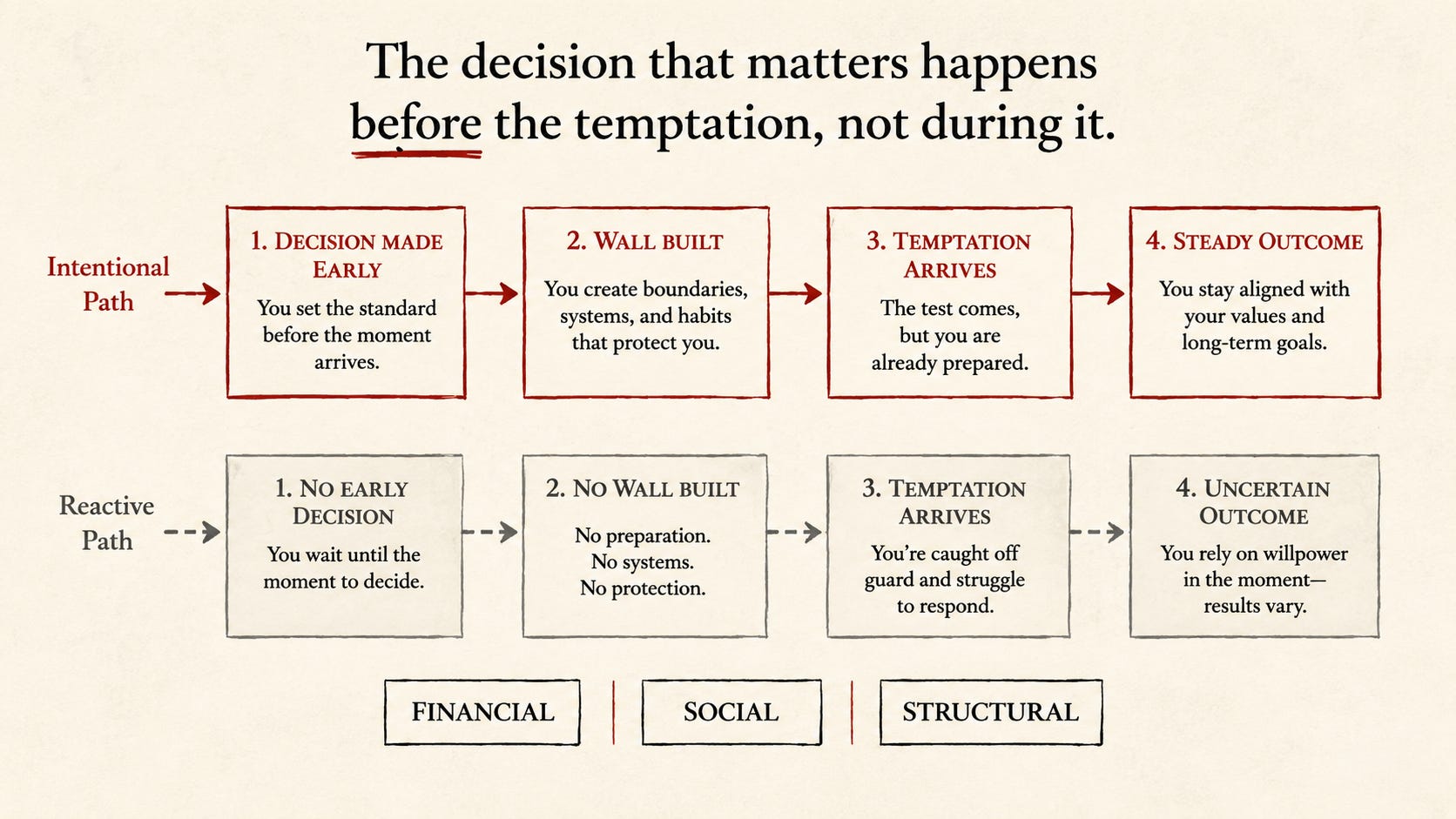
None of this requires waiting for a dramatic turning point or a new year to begin. Ulysses did not wait for a better version of himself to show up before the ship reached the sirens. He used the version of himself available on calm water, the one still capable of clear judgment, to make one binding decision that the frightened, tempted version of him would later be powerless to undo. That is the entire method, available on any ordinary afternoon, requiring no more resolve than it takes to book a call, sign a form, or turn a chair around.

The One Thing to Do Today
Identify one decision you keep losing to your tired, distracted, later self, and build one piece of real friction against backing out of it, not just a reminder to try harder. A cancellation fee, a public commitment to someone who will notice, a deadline with an actual cost attached. Make the wall now, while you are thinking clearly, rather than trusting the version of you who shows up later to fight the same fight again.
This piece is part of an ongoing series on how discipline actually functions, drawn from the same research, including its genuine complications, that shapes everything published here at Deliberate Project.
See you next time,
The Deliberate Project Team
References
1. Baumeister, Roy F., Ellen Bratslavsky, Mark Muraven, and Dianne M. Tice. “Ego Depletion: Is the Active Self a Limited Resource?” Journal of Personality and Social Psychology, 1998.
2. Guarana, Cristiano L., Ji Woon Ryu, Ernest H. O’Boyle Jr., Jaewook Lee, and Christopher M. Barnes. “Sleep and Self Control: A Systematic Review and Meta Analysis.” Organizational Behavior and Human Decision Processes, 2021.
3. Mischel, Walter, Ebbe B. Ebbesen, and Antonette Raskoff Zeiss. “Cognitive and Attentional Mechanisms in Delay of Gratification.” Journal of Personality and Social Psychology, 1972.
4. Ariely, Dan, and Klaus Wertenbroch. “Procrastination, Deadlines, and Performance: Self Control by Precommitment.” Psychological Science, 2002.
5. Thaler, Richard H., and Shlomo Benartzi. “Save More Tomorrow: Using Behavioral Economics to Increase Employee Saving.” Journal of Political Economy, 2004.
6. Duckworth, Angela L., Christopher Peterson, Michael D. Matthews, and Dennis R. Kelly. “Grit: Perseverance and Passion for Long Term Goals.” Journal of Personality and Social Psychology, 2007.