

You do not need more willpower to exercise, study, or do the tedious task you keep avoiding. You need to lock it to something you already crave.

Katy Milkman, a behavioral scientist at Wharton, had the same problem most people have with the gym. She wanted to go. She rarely felt like it once the day actually arrived. What she wanted more than the workout, if she was honest with herself, was to know what happened next in the page-turning audio novel she had been listening to in her car. So she made herself a rule that she could only listen to that audiobook at the gym, nowhere else. Within weeks she was showing up five days a week, not because her discipline had improved but because she had made the thing she wanted depend entirely on the thing she kept avoiding.
She eventually gave the strategy a name, temptation bundling, and then did something most people with a good personal hack never bother to do. She tested it properly, on strangers, with a real research design, to see whether the trick that worked on her would work on anyone else. That decision to test her own hunch rather than simply publicize it is the reason this piece exists at all, since most personal productivity tricks never survive contact with a control group.
I. The Rule She Made for Herself
The logic behind Milkman’s rule is simple enough to describe in one sentence. Make the desired (story) accessible only during the required (exercise). The workout stops being a cost you pay for future health. It becomes the price of admission to something you already crave today.
This piece explores how an idea fares when tested formally outside personal experience and what research suggests for tasks you avoid. It is a fair question to ask of any personal productivity story, since plenty of tricks that work beautifully for the person who invented them fall apart the moment someone tries to systematize them for a stranger.
II. Why Willpower Alone Underperforms Here.
Roy Baumeister’s research on self-control fatigue has faced serious challenges from large replication efforts in recent years, and the specific mechanism remains genuinely contested among researchers. What survives that debate on sturdier ground is simpler. Self-control varies with sleep, stress, and daily decisions; a meta-analysis of 61 studies confirms this pattern at individual and night-to-night levels.
This fluctuation explains a familiar contradiction most people never fully articulate. Later, the self who planned to exercise may lack the energy to follow through. Advice that simply asks for more resolve ignores this entirely, treating every hour of the day as though it offered the same fair fight.
That fluctuation explains why a person can genuinely want to exercise and still skip it most evenings. The want is real. It simply loses every time it has to compete, fresh, against fatigue and a dozen easier options sitting right there. Temptation bundling does not ask that want to win a fair fight against fatigue. It changes what the person is actually choosing between in the moment: not exercise versus the couch, but the story versus silence.
III. Mischel’s Real Insight, Applied to Boredom
The wrong headline about Walter Mischel’s marshmallow studies remembers a correlation between childhood patience and later success, which diverse replications have not upheld as well as originally reported. What has held up is the mechanism inside the room. Children who waited successfully reframed the marshmallow, imagining it as a photograph rather than an actual object, which made resistance far easier than staring directly at the thing they wanted. Children who struggled kept the treat visually present the entire time, which kept its pull vivid and made the wait feel far harder than it needed to.

Temptation bundling runs the same reframe in the opposite direction. Instead of making a tempting object feel less real to resist it, it makes a tedious task feel more desirable by affixing a genuine want to it. The exercise itself does not change. What changes is which experience the brain is actually expecting when the person thinks about going to the gym. Mischel taught children to look away from what they wanted. Milkman effectively taught adults to look toward what they wanted and simply moved the location of that which went on top of the task they kept avoiding.
Both strategies share a deeper principle worth naming directly. Neither one asks a person to change how much he wants something. Both work by changing where that went physically sits relative to the task at hand, whether that means turning attention away from a marshmallow or pulling a genuinely desired story into the middle of a workout. Desire, in this framing, is not something to suppress or generate more of. It is something to redirect.
IV. The Hunger Games Experiment
In 2014, Milkman published a field experiment with Julia Minson and Kevin Volpp testing temptation bundling in a randomized field study. The researchers split two hundred and twenty-six participants into three groups. One group received iPods loaded with page-turning audiobooks, the kind commonly described as guilty-pleasure reading, that worked only inside the gym, physically locked to that location through the device itself. A second group received the same audiobooks with encouragement to restrict their own listening to the gym, but no actual lock preventing them from listening anywhere they liked. A third group received a gift card of equal value and no bundling instructions at all, and researchers measured the other two groups against this group.
The results favored restriction heavily. Participants in the fully locked condition visited the gym fifty-one % more often than the control group over the ten-week study. The encouraged but unlocked group still improved, twenty-nine% more visits than control, but noticeably less than the group with no choice. The effect faded somewhat after a Thanksgiving break interrupted everyone’s routine, a detail worth remembering before assuming any single habit intervention survives a real disruption untested. Sixty-one % of participants voluntarily paid to keep the restriction, showing they valued the loss of cheating freedom.
That willingness to pay deserves more attention than it usually gets. People who had just spent ten weeks living under a restriction chose, with their own money and with the study already concluded, to keep restricting themselves further. That is a strange thing to do if the restriction had felt purely like a cost. It suggests the participants experienced the locked access less than a punishment and more than useful scaffolding, the same relief a person feels when they have already decided and there is nothing left to negotiate.

Richard Thaler’s work on loss aversion explains why the locked condition outperformed the merely encouraged one by such a wide margin. Once a person has grown used to a restriction, removing it registers as a loss, and people work harder to avoid a loss than to pursue an equivalent gain. A participant who had spent weeks treating the audiobook as something earned through exercise had built a small sense of ownership over that arrangement, and giving it up voluntarily meant surrendering something that felt like his. The unlocked, encouraged group never built that same sense of loss, because they never actually lost anything if they cheated.
The exercise did not become easier. The story simply made the alternative unbearable to sit through.
V. Does It Actually Stick? Duckworth’s Own Follow Up.
The original study was small, two hundred twenty-six people at one university gym, and Angela Duckworth herself joined a later team to test whether the effect would survive at scale and without the heavy-handed restriction Milkman’s original design relied on. The 2020 follow-up, running roughly fifteen times larger, asked a more honest question. What happens if people are simply taught the idea and given a free audiobook, rather than having their access physically locked to the gym?
Duckworth’s involvement here matters beyond the credential. Her own research on long-term persistence has always centered on what survives past the point where a novel intervention stops feeling exciting, and this follow-up applies exactly that lens to Milkman’s original finding. A clever trick that only works when researchers control physical access to an audiobook is not much of a trick a person can actually deploy on his own. The question worth asking was never whether restrictions worked. It clearly does. The question was whether an ordinary person, without a lab locking anything down, can build something similarly effective for himself. Answering that question honestly is what separates a real behavior change tool from an interesting story about one person’s gym habit.
The answer that emerged was smaller, but real. Teaching the strategy alone produced only a small lift, about four % more likely to visit the gym in a week during the intervention period, rising to a more meaningful six % increase in the ten weeks after the program ended. Offering a free audiobook alongside encouragement boosted event visits by 10% and increased the likelihood of attendance, a statistically significant finding.
Seventeen weeks after the program concluded, participants who received instruction in the strategy still exhibited a ten to fourteen % higher probability of exercising weekly compared to those who did not. They averaged approximately ten to twelve % more workouts. This persistence detail matters more than the headline effect size, since most behavior change interventions in the research literature fade quickly once the researchers stop watching. A lasting result four months post-coaching is rare, suggesting the mechanism of pairing desire with avoidance persists.
A pattern across both studies tells a consistent story, and it is worth stating plainly rather than burying in a footnote. Restriction beats encouragement, and encouragement beats nothing, in that order, every time it gets tested. This mirrors a finding from an entirely different corner of pre-commitment research, where self-imposed deadlines improved performance, but externally imposed ones improved it more. Removing your own flexibility, rather than merely announcing an intention, appears to be where most of the actual benefit lies, regardless of which specific behavior researchers are studying.
Restriction beats encouragement, and encouragement beats nothing, in that order, every single time it gets tested.
Building Your Own Bundle
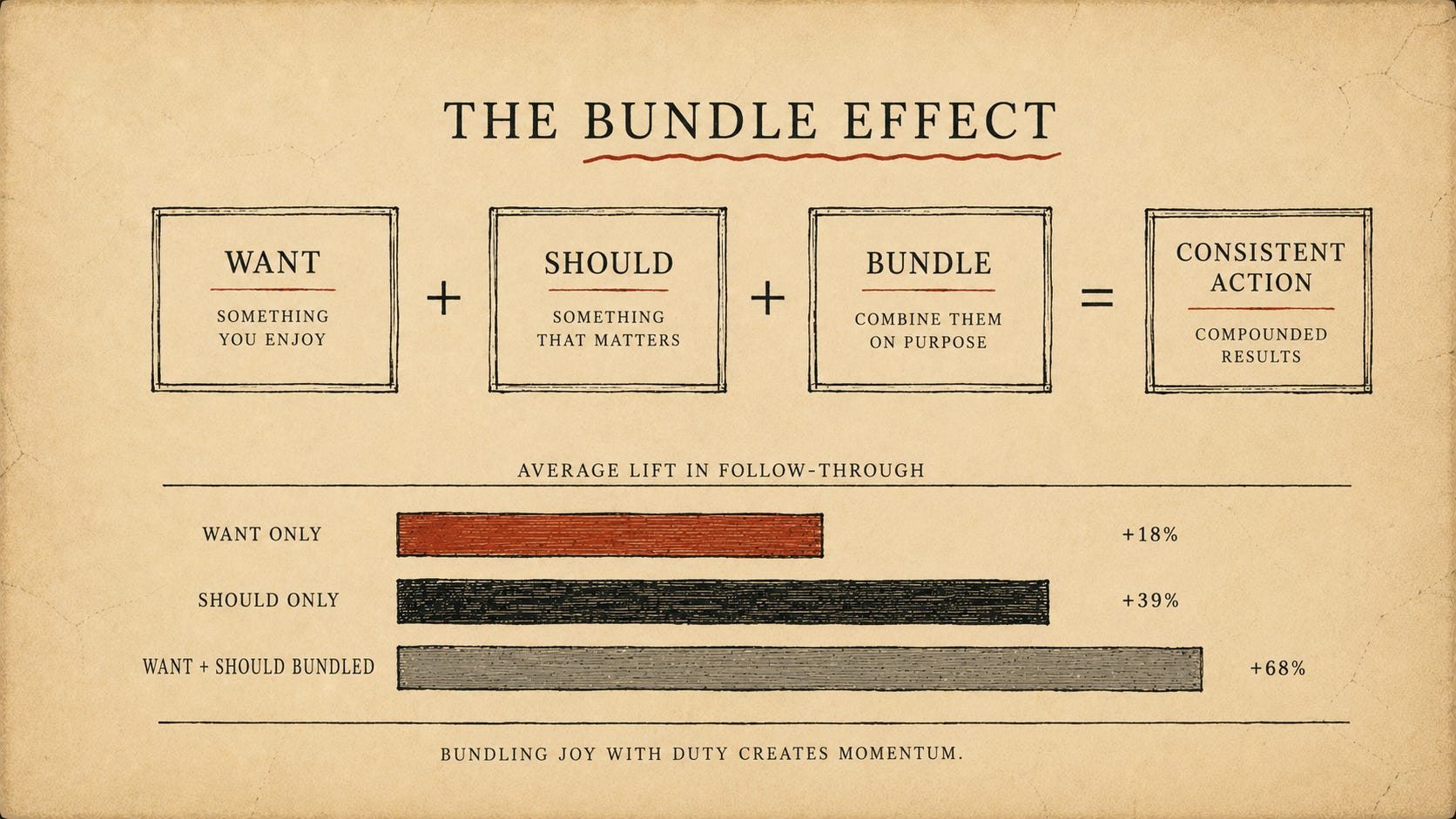
Two honest ingredients matter more than any clever framing, and a bundle missing either collapses fast. It needs a want strong enough that losing access to it actually stings, not a mild preference but something close to a genuine craving, the show, podcast, or story a person actually looks forward to. It requires genuine restriction, not a private agreement to use it appropriately, but a locked app, a gym-only downloaded show, or a subscription that activates only during desired behavior.
The size of the want matters more than most people expect going in. A mildly pleasant podcast produces a mildly pleasant bundle, and a mildly pleasant bundle is exactly what quietly stops mattering the first time a schedule gets tight. The research points toward genuine craving, something closer to what Milkman felt about her audiobook, as the threshold worth aiming for. If the want would not survive being taken away for a week without some real annoyance, it is probably not strong enough to carry the should behavior on its back.
Building around Milkman’s Thanksgiving disruption matters more than ignoring it. Any bundle will eventually meet a broken week, a holiday, an illness, a trip. Plan your return to good habits before they falter. Treating the disruption as inevitable, rather than as evidence that the entire system failed, keeps one terrible week from turning into an abandoned habit.
My version of this, built after reading through this research rather than stumbling into it the way Milkman did, ties a specific true crime podcast to the least favorite part of my week: folding laundry. I do not particularly enjoy folding laundry more than I used to. I simply stopped noticing how long it takes because the thing I am actually paying attention to has nothing to do with laundry at all. The task did not get easier. It got quieter, crowded out by something I would have spent time on, anyway.
What makes this approach worth taking seriously, more than any single number from either study, is how little it resembles most discipline advice. It does not ask a person to want the avoided task more, to visualize success, or to draw on some deeper well of resolve that may or may not exist on an evening. It asks him to notice what he already wants, honestly and without judgment, and to place that want somewhere useful instead of somewhere idle. The craving was never the problem. Where it was sitting was.
This is also, in its own quiet way, a kinder way to think about the whole subject than most discipline writing manages. It does not treat wanting things as a weakness to overcome on the road to becoming a more disciplined person. It treats wanting things as raw material, a resource sitting mostly unused, waiting for someone to notice it could do far more useful work than sitting idle in a car during the commute home.
The One Thing to Do Today
Pick the task you avoid most reliably, and identify one genuine want, a show, a podcast, an audiobook, strong enough that losing it would actually bother you. Build one real restriction around it today, not a promise but an actual barrier, so the want only becomes available inside the avoided task. Do not wait for a full system. Lock the first pair tonight.
This piece is part of an ongoing series on how discipline actually functions, drawn from the same research, including its genuine limits, that shapes everything published here at Deliberate Project.
See you next time,
The Deliberate Project Team
References
1. Baumeister, Roy F., Ellen Bratslavsky, Mark Muraven, and Dianne M. Tice. “Ego Depletion: Is the Active Self a Limited Resource?” Journal of Personality and Social Psychology, 1998.
2. Guarana, Cristiano L., Ji Woon Ryu, Ernest H. O’Boyle Jr., Jaewook Lee, and Christopher M. Barnes. “Sleep and Self Control: A Systematic Review and Meta Analysis.” Organizational Behavior and Human Decision Processes, 2021.
3. Mischel, Walter, Ebbe B. Ebbesen, and Antonette Raskoff Zeiss. “Cognitive and Attentional Mechanisms in Delay of Gratification.” Journal of Personality and Social Psychology, 1972.
4. Milkman, Katherine L., Julia A. Minson, and Kevin G. M. Volpp. “Holding the Hunger Games Hostage at the Gym: An Evaluation of Temptation Bundling.” Management Science, 2014.
5. Kirgios, Erika L., Gregory H. Mandel, Yeji Park, Katherine L. Milkman, Dena M. Gromet, Joseph S. Kay, and Angela L. Duckworth. “Teaching Temptation Bundling to Boost Exercise: A Field Experiment.” Organizational Behavior and Human Decision Processes, 2020.
6. Ariely, Dan, and Klaus Wertenbroch. “Procrastination, Deadlines, and Performance: Self Control by Precommitment.” Psychological Science, 2002.
7. Knowledge at Wharton. “Using ‘The Hunger Games’ to Encourage Healthier Choices.” The Wharton School, University of Pennsylvania, 2013.