

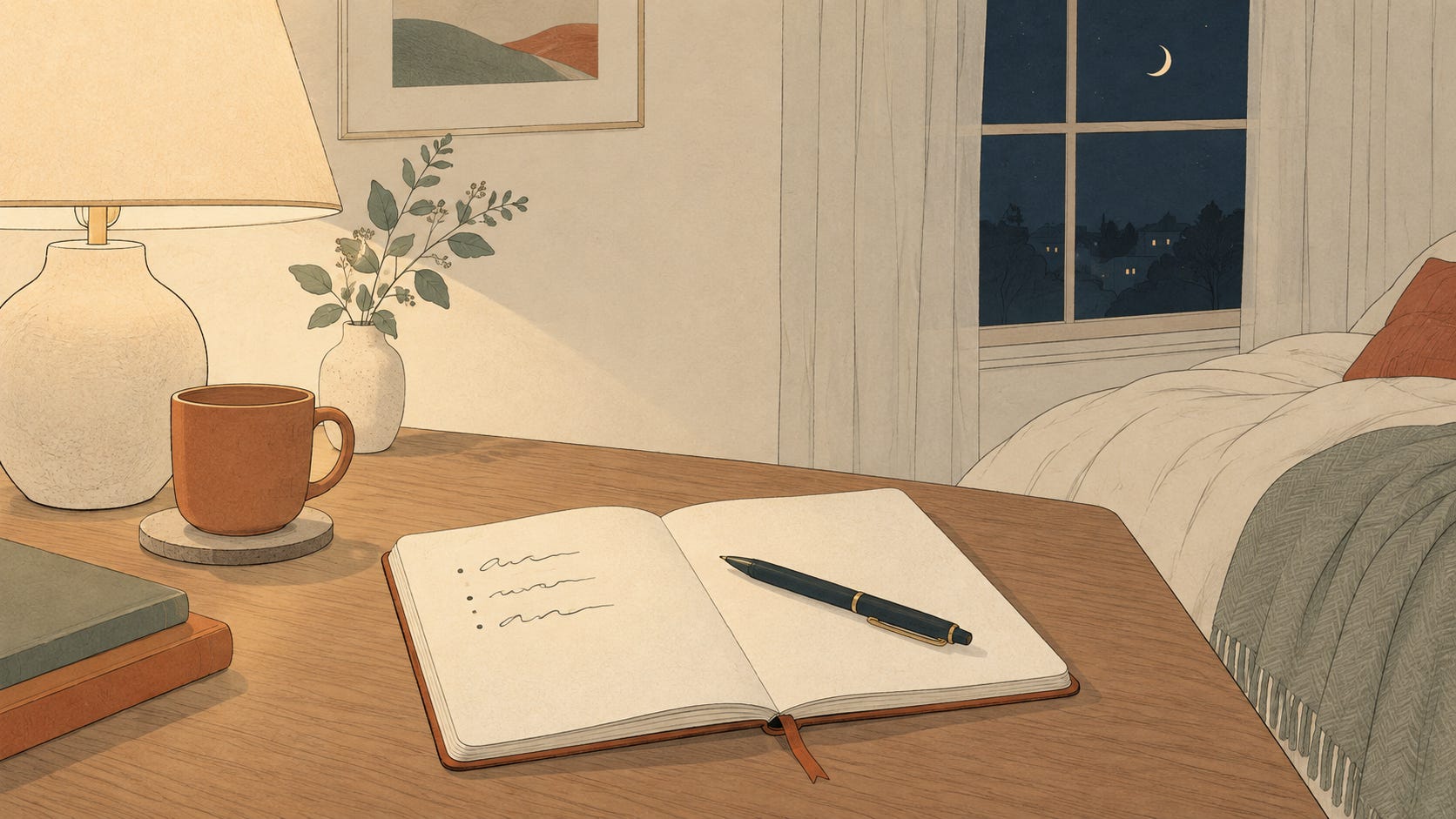
Most nights, I used to close the laptop and carry the whole next day to bed with me.
The tasks did not stay on the desk. They followed me upstairs, arranged themselves across the ceiling, and kept me company long after the lights went out. I assumed this was simply what a full life felt like at eleven at night.
I tried the usual remedies first: an earlier screen curfew, a quieter room, less light. None of them touched the real problem: an unfinished list with nowhere to land.
Then I tried something almost embarrassingly small.
I wrote tomorrow down.
Nothing about my schedule changed. Only the location of the list changed—from inside my head to a page beside the bed.
Five Minutes Before Bed
Psychologist Michael Scullin and his colleagues at Baylor University tested this idea in a sleep laboratory.
They studied 57 healthy adults between the ages of 18 and 30. Before bed, each person spent five minutes writing. One group wrote a to-do list for the next few days. The other wrote about tasks they had already completed.
The team randomly assigned the participants. Everyone went to bed without technology or homework. Researchers then used polysomnography—the standard sleep-lab method that records brain waves and eye movements—to measure how long it took each person to fall asleep. Read the study here.
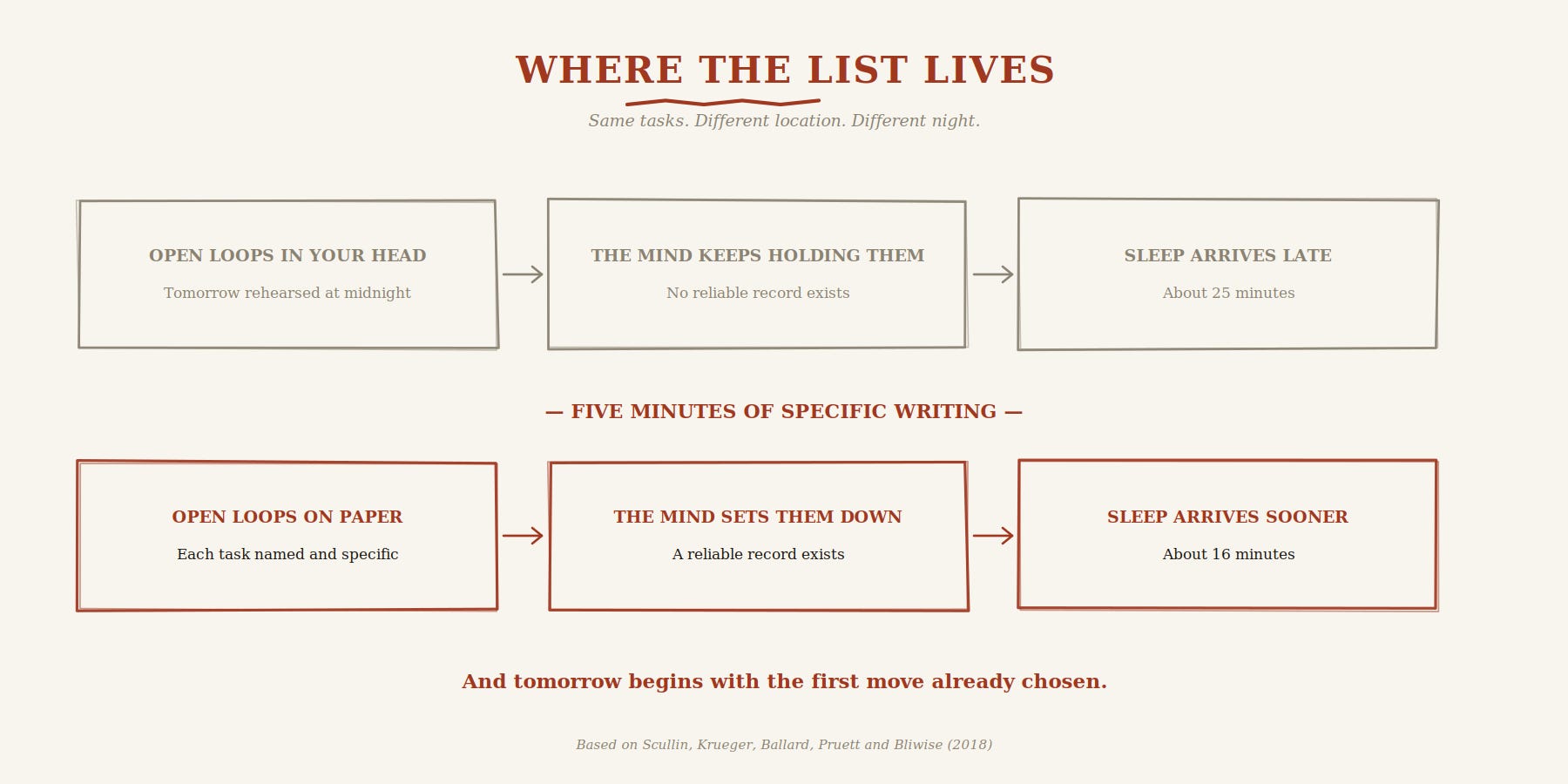
The people who wrote a to-do list fell asleep in about sixteen minutes. The people who wrote about completed tasks took about twenty-five minutes.
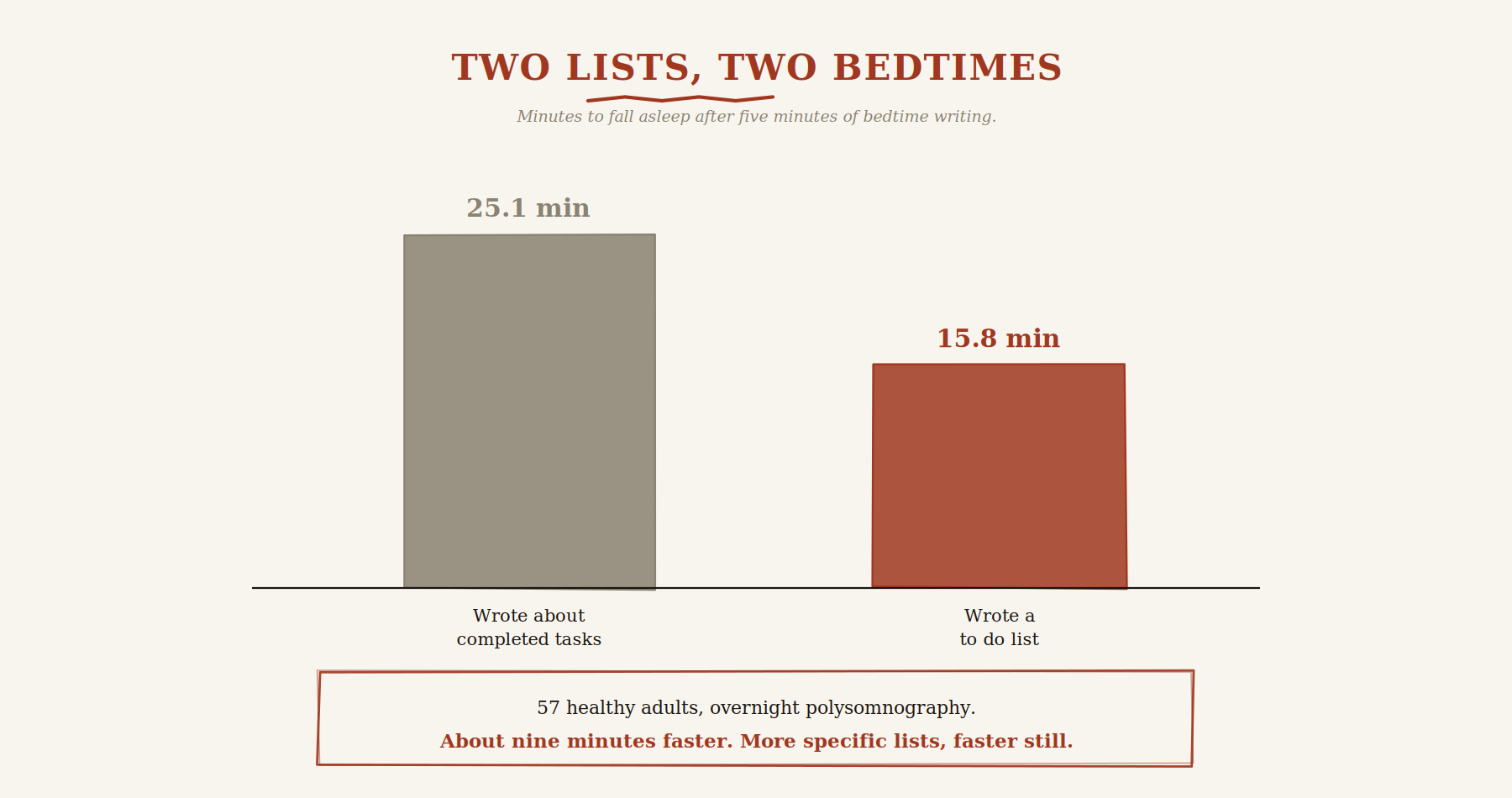
That is a difference of roughly nine minutes.
The most useful detail was this: among the people who wrote to-do lists, those who made their lists more specific fell asleep faster.
“Handle finances” leaves your mind with a foggy obligation. “Open the budget file and update three categories” gives tomorrow a first step.
Why It May Work
Unfinished tasks keep asking for attention.
Your mind returns to them because it doubts you will remember them. Writing them down creates a reliable place for them to live. The page becomes responsible for holding the task, so you do not have to.
That does not mean a to-do list solves every sleep problem. This was a small study of young, healthy adults, not a treatment study for insomnia. But it suggests a simple idea worth trying: when tomorrow has a place to wait, your mind may find it easier to stop rehearsing it.
The One Thing to Do Tonight
Tonight, set a timer for five minutes shortly before bed.
Write a short list for tomorrow on paper, not on your phone. Make each item specific enough that you could begin without deciding what it means.
Instead of:
Handle finances
Write:
Open the budget file and update three categories.
Instead of:
Work out
Write:
Put on walking shoes and walk around the block for ten minutes.
Put the item that matters most at the top. Do not capture every obligation. Choose a handful of tasks that would make tomorrow feel like progress.
If another task comes to mind after the timer starts, add it to the page. When the five minutes end, stop.
Close the notebook. Leave it where you will see it in the morning.
The list can carry the worry for the night. That is its job.
For Tomorrow Morning
The benefit is not only faster sleep.
When the list already exists, tomorrow begins with less negotiation. You have already selected your first move. Instead of spending your sharpest hour deciding what deserves attention, you can begin.
Tomorrow starts one decision ahead.
Small decisions do not always feel important in the moment. But they compound. A five-minute list at night can lead to a calmer evening, a clearer morning, and a day that starts moving before doubt has time to take over.
Related Reading
If this idea landed, these two pieces pair well with it:
Why Changing Your Habits Starts With Changing Your Identity — I explain in this article how lasting habit change begins by building identity through small, repeated actions that create evidence.
You Are Not Finding Yourself. You Are Building Yourself. In this article, I argue that repeated actions and deliberate choices build identity, rather than simply discovering it.
Read them in that order. The evening list becomes the first step in a morning that starts moving on its own.
Go Deeper with Membership
Borgella Street Journal publishes free pieces like this one alongside longer paid essays on habits, identity, discipline, and decision-making.
Members receive the complete quarterly issue, full access to the archive, and deeper research-backed essays with practical frameworks that they can use immediately.
If this essay helped you think more clearly about tomorrow, membership gives you the deeper work behind it.
Read the complete quarterly issue, explore the archive, and support research-backed writing on habits, identity, discipline, and deliberate living.
See you next time,
Pierre Poteau
Borgella Street Journal