

I have been the type of person who starts things and leaves them unfinished. I was correct in saying such about myself, as evidenced by the stacks of unfinished notebooks, side projects, and sets of notes left behind. That label of mine, however, ceased to be accurate, if briefly, when one of many times it had ceased to be true and I still vocalized it.

When I published my first book, I realized the label bore no resemblance to my activities of the previous three years. I had finished the book I had previously left unfinished, as well as the next book. And in casual settings, I would still refer to myself in this manner, as I automatically pulled on the old adverse evidence because I never took the time to revise the story I had built around it.
It was later that I realized how specific this gap was. Not that I did not feel I had made progress, more that I lacked the security to detail my accomplishments. It was a label used to describe me without thought, like a brief introduction to a stranger, ignoring my real details.
This gap, between what a person has actually done and the story they keep telling about themselves, is actually pretty common and has led psychologists to spend a lot of time figuring out how and when that gap closes. Their answer is actually more complex than most advice on developing your identity. It explains why my label has taken so long to catch up with the facts. That they haven’t collected the evidence doesn’t matter. It is in fact that evidence, just because it is used, that revises the identity, no matter how extensive evidence sits unused.
Dan McAdams, a psychologist who has had a long career at Northwestern studying what he calls narrative identity, claims that your identity is not a trait that is fixed somewhere within you. That identity is in fact an internalized life story that you’ve constructed and are continuously revising in order to incorporate both your past and future to have a sense of both integration and meaning within your life. That identity, although narrative in many respects, certainly does not summarise a life that has already been lived. It is an interpretation that can be right or wrong for a long time before anything external makes it necessary to change that.
To provide structure and verify the methods of life story interviewing, McAdams designed the Structured Life Story Interview. This method calls for describing one’s life in chapters with significant scenes. Trained coders rate these interviews on coherence and emotional turning points, making the research measurable.
McAdams’ research identifies a specific mechanism behind why some stories update and others calcify. Using structured life story interviews, his team distinguished redemption sequences from contamination sequences in people’s narratives. In a study of midlife adults and college students, redemption sequences in personal narratives were positively associated with self-reported psychological well-being, while contamination sequences predicted lower well-being among the midlife adults specifically.
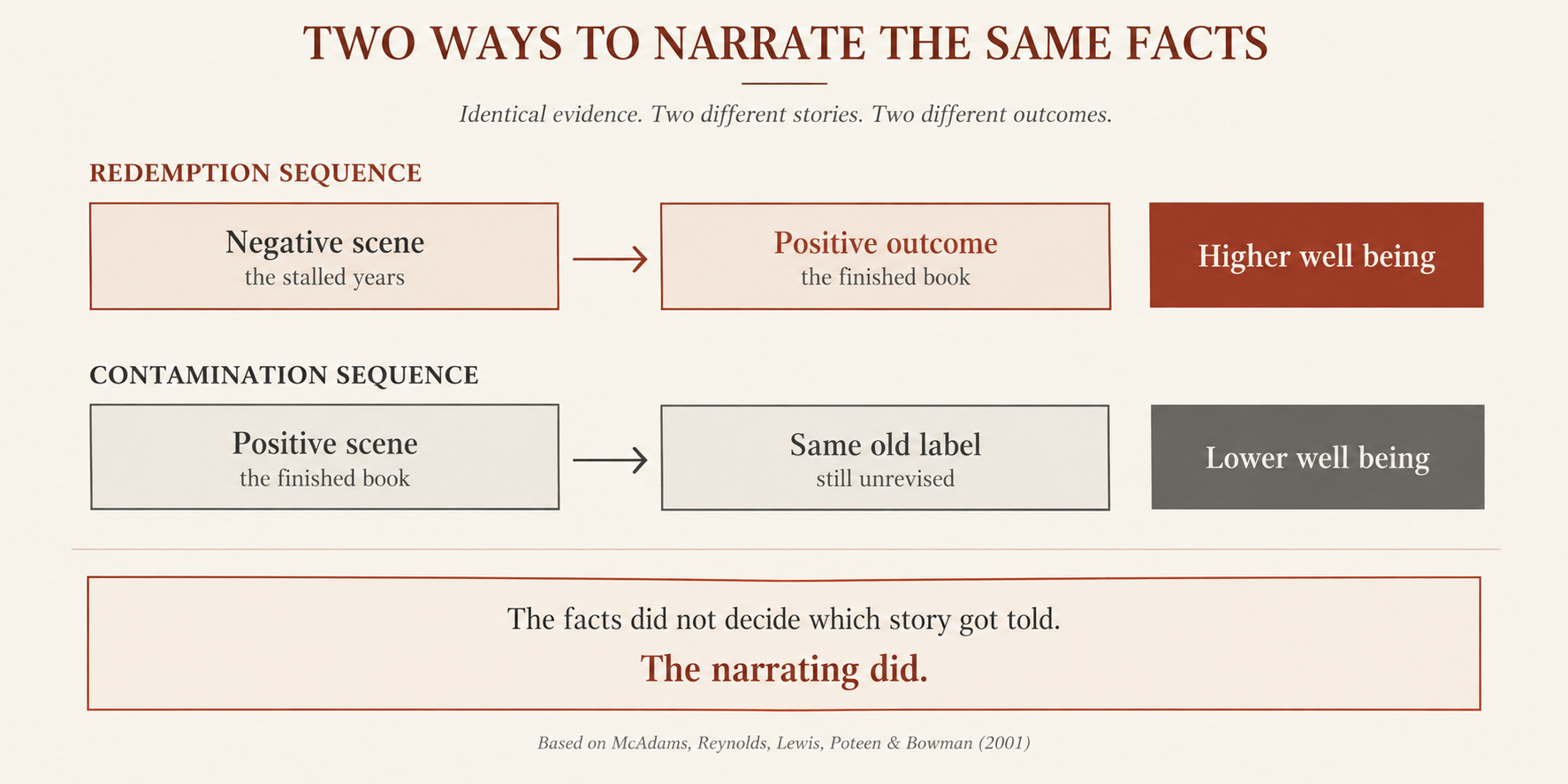
What makes this finding useful rather than simply descriptive is what it has to say about revision. Just because there’s new, internally valid evidence doesn’t mean the story automatically changes. For the story to change, someone must narrate the evidence, and the way they narrate it will influence how the story changes. The same failure and recovery can lead to two different outcomes: one unredeemed, the other redeemed, with lasting emotional impact, as McAdams suggests.
This distinction has been useful to me in understanding my label. I have clear, positive evidence available to me. The finished book is a great example of that. What I have lacked is the narration of that evidence as a critical point in my story of achieving closure. The published book resides in my memory as an isolated fact that still does not represent a redeemed closure to a story, which would update the label I have given it.
This is where I see my label stalled. I wasn’t lacking positive evidence. I had published a book on my shelf that showed the old story was obsolete. What I lacked was narrating the evidence at all. I kept telling the old story. For a story to be revised, the facts may have changed, but a revised story will not tell itself.
This is where most identity advice gets the order wrong when explaining how to journal for self-understanding. People are led to believe that enough self-reflection will provide the answer. In his research, McAdams suggests that reflection is much less important than the decisions made post-reflection. Most people will simply journal their thoughts in chronological order, which has little to no effect on how the events are narrated. More reflection has little to no effect on the narratives that are told. The revision results from a consciously directed reframe and not from simply more reflection.
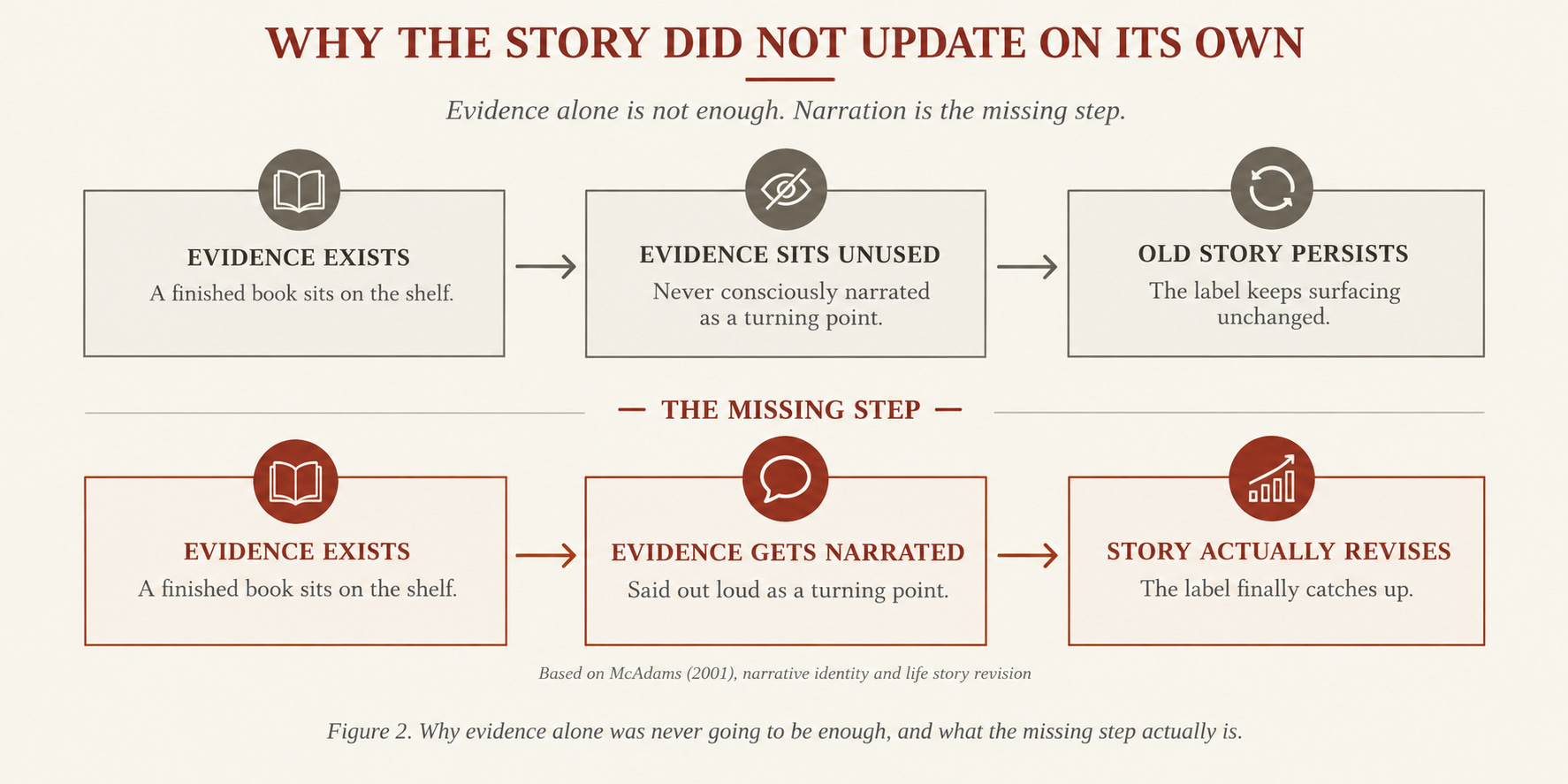
Individuals might not consciously attribute deliberate acts to personal growth, but those acts help add clarity to the growth that was there all along. The finished book, the promise kept, the milestone reached after a tough year are all precisely those actions that can be used to mark a turning point in a person’s narrative. Rather than leaving those facts floating in lifeless solitude, they are brought into the center of the narrative. There is no longer a need for the ear of a friend to hear factually inaccurate tales of progress, since that person has now fully owned their narrative.
While people may not know why, there is evidence to suggest that the structure of positively reframing a narrative has a positive effect, outside of reconciling an inaccurately used label. Revising a narrative is clearly not the emotional filing of facts. It is an active, emotional process.
I eventually did this with my label, but it took an embarrassing conversation with a friend who told me, point blank, that I had published two books whilst still calling myself someone who doesn’t finish things. Calling the gap aloud got more done than just noticing the evidence privately for months on end. The old story would not cease being the case just because I stopped thinking of it; I literally had to say the new story before I could believe it to be true.
The One Thing to Do Today
Choose one example from last year that disagrees with a label you still use for yourself, and exaggerate the new version of this example to someone as a turning point, instead of a quick passing comment. The story becomes more interesting the more you tell it. It isn’t about waiting for information to accumulate.