


I sat down at my computer with 11 open tabs and a list of 7 things to do with the feeling that they all needed to get done. Around 9 I was rewriting my to-do list and not actually checking things off, as if the order of the things on the list would tell me which one I should do first. Then I answered the email that was due at noon, then the one that was due at 2, then a form that closed. I stopped when I got the urge to go on YouTube and try to find a lesson about being productive. Being productive felt good, and my inbox was looking great, but my chapter, the one I had been meaning to finish for 3 weeks, was not even a quarter of the way done and wasn’t even close to being due. What bothered me wasn’t the time I lost. It was how reasonable each choice I made felt.
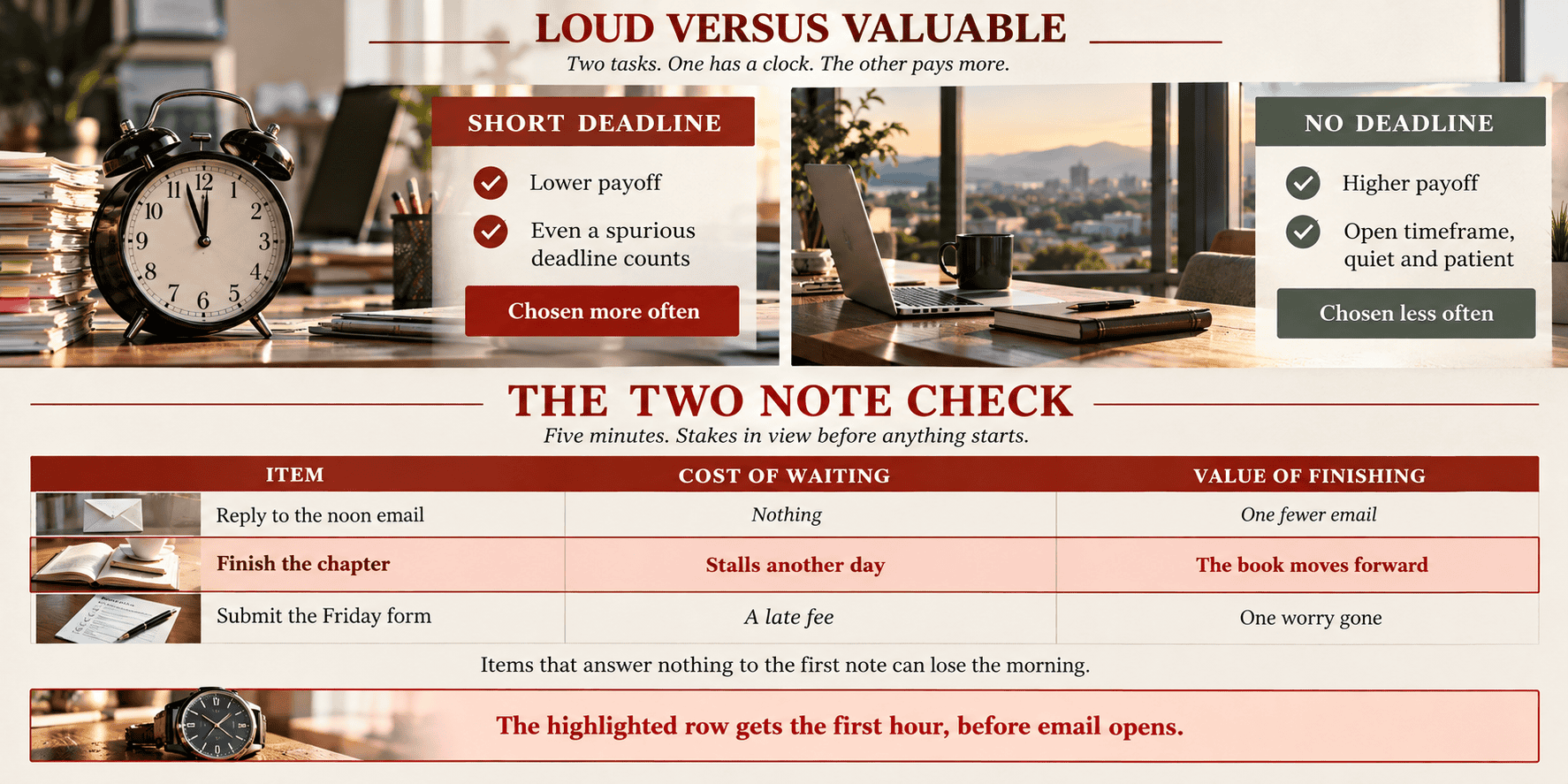
Zhu, Yang, and Hsee did five studies to test this exact phenomenon. They gave participants a choice between two tasks. The clearly better payoff task was always available. The other task had a smaller payoff but had a deadline that was sometimes an illusion and had no effect on the outcome. The rewards were small, a few cents online, a couple pieces of candy in the lab, a chance to win a gift card. They also dismissed reasons that might explain choosing the illusory deadlines task, like it being easier or having a smaller payoff. People still chose the lower-paying task more often when it carried even a spurious deadline. The important thing is that they called it the mere urgency effect. The existence of a false deadline means the pull comes from the clock, not from any actual cost of missing it.
The clock pulls focus. A time limit on a task pulls focus toward the time limit and away from the reward. This means that the time limit actually decides. For this reason, the outcome is often overlooked. Because of a time limit, the concentration is on the time limit, so the outcome of the choice is often neglected. For this reason, an email that is due at noon is more difficult to put off than a chapter that is due at some point. This is even more true when there are limits on work. These limits often show a task with a time limit, and other tasks with no time limit and/or no reward.
A second line of research explains why a crowded day sharpens this. Anuj Shah, Sendhil Mullainathan, and Eldar Shafir found that scarcity, including having too little time, pulls attention toward the pressing demand in front of a person and away from everything else.
The researchers call the phenomenon “tunneling”: the more a person directs his or her cognitive resources to the urgent issue, the less is left over for the other issues. In their lab game, players in a time crunch often borrowed against time in later rounds. They almost always ended up worse off. The same feeling describes how the sun appears to set earlier on the other side of the mountain. When a day feels short, the nearest deadline takes all the light.
Alongside this phenomenon, there is another. Many people have described how they feel as though they’re going through a really important day when they experience the feeling of being busy or feeling rushed. When everything is important, sometimes many things are really loud. The feeling is genuine, but it tells you more about the clock than the situation itself.
The Zhu team also found a way out. When the researchers highlighted the payoffs of both tasks at the moment of choice, the pull of the urgent task weakened, and the difference in what people chose disappeared.
Stakes are information that has to be made visible at the right time. The person then decides when they don’t feel calm or motivated to try. The information has to be right in front of them. A to-do list is a list of tasks, but stakes are the part that decides.
What follows is easy to describe. The morning becomes a choice amongst items whose stakes you have actually looked at. Some tasks become smaller. Quieter ones, like a chapter or a conversation or an application, show you how much they cost you every day you don’t do them. Every item on the list becomes smaller, and the things that remain take a name instead of a deadline.
The One Thing to Do Today
For each item on your list, write two things on a piece of paper. First, describe the impact of waiting until tomorrow, e.g. “nothing,” “a late fee,” “a missed window,” “my chapter stalls another day.” What happens if nothing happens? Who would notice? The point is to just provide a quick reason. A long, drawn-out explanation for just one item is a waste of time and takes away from the goal of figuring out the cost of waiting for every single item on your list. Second, provide a quick reason for finishing the item, e.g. “one fewer email,” “the book moves forward.” Expect surprises. Items that you thought would have a high cost of waiting answer with a low cost of waiting, and a few minor items on your list surprise you with a high cost of waiting. Items that you thought would take just a few minutes actually do take just a few minutes to do. Now, pick the one item with the highest cost of waiting and do it first. This may take away from your planned work/study time for the day, so plan accordingly. Resist the urge to alphabetize or organize your list of reasons. This takes just a few minutes and sets you up for making the choices that lead to the biggest impact for the work you plan on doing for the day.
Related Reading
There are two other pieces that pair with this one. The Habit That Makes Tomorrow Easier demonstrates the impact of a five-minute to-do list this evening that gives you the first move before the clock yells. What Your Calendar Actually Says About Your Priorities, from the Borgella Street Journal, discusses your calendar and what it reveals about your priorities. When read together, the list, the calendar, and the first hour point in the same direction. Each piece addresses a different way of considering the same question: what is today about? Each takes only a few minutes to use.
Go Deeper With a Membership
Deliberate Project publishes free pieces like this one, as well as paid pieces that take the idea further. A paid piece takes a question, for example, why urgency is more important than importance, and analyzes the original studies, providing sample size, effect size and the study’s limitations, and explains what headlines skip. This way you get to see the evidence firsthand as opposed to taking someone’s word for it. Each piece ends with a practice/actionable template that you can implement immediately. Free readers develop the habit, and members get the evidence behind it. If you want to see the research behind the habits and implement it into your life immediately, this is your best bet.
Reply and tell me which item on your list costs nothing to wait on. I would like to know how many there were, and which one surprised you the most.
Have advice, a letter, or a suggestion for us? Send it to kanpoteau@gmail.com.
See you next time.
The Deliberate Project Team
References
1. Zhu, Meng, Yang Yang, and Christopher K. Hsee. “The Mere Urgency Effect.” Journal of Consumer Research, 2018.
2. Shah, Anuj K., Sendhil Mullainathan, and Eldar Shafir. “Some Consequences of Having Too Little.” Science, 2012.