


I broke a four-month running streak on a Tuesday in March. Not for any dramatic reason; it was just a long day that ran long. What surprised me later, though, was not the missed run. It was the sentence that followed it. You always do this; you were never actually going to keep it up. One missed run became a verdict on my character, and I hadn’t even put my shoes away before that was the case.
Looking back, the oddest thing was how automatic that sentence was. I didn’t really analyze the missed run. I didn’t really consider the reason I had for missing it. This all happened much faster than any sort of real analysis could have produced it.
I have had conversations with enough other people about their broken habits to see that this happens with almost everyone, and that there is something significant tied to it about what happens next. The run itself is never the decision. The sentence that follows it is.
Conversations with enough other people about their own broken habits have shown me this reaction is close to universal, and also that it predicts something specific about what happens next. The run itself was never the actual decision point. The sentence that followed it was.
Psychologists Alan Marlatt and Judith Gordon studied exactly this moment decades ago, working initially with people recovering from substance use, and identified a pattern they called the abstinence violation effect. The effect describes a specific internal reaction to a lapse; one built from three particular kinds of explanation a person reaches for without noticing he is choosing them. An internal explanation blames something fixed about himself rather than the situation. People consider the cause of permanent rather than a onetime circumstance with a stable explanation. A global explanation allows failure to spread across his entire identity rather than being localized to the broken habit.
If this changed how you think about it, the like button helps the next reader find it. Want to go further? Subscribe below.
Based on existing research on explanatory style, Marlatt and Gordon outlined this three-part structure to study the moment right after a lapse, especially for depression. One of the biggest insights from this research was not about explanations; people already believed and understood the importance of giving explanations. The insight was that this combination of the three elements predicted whether a lapse would stay a lapse or turn into a full relapse. It made this prediction with a high level of accuracy.
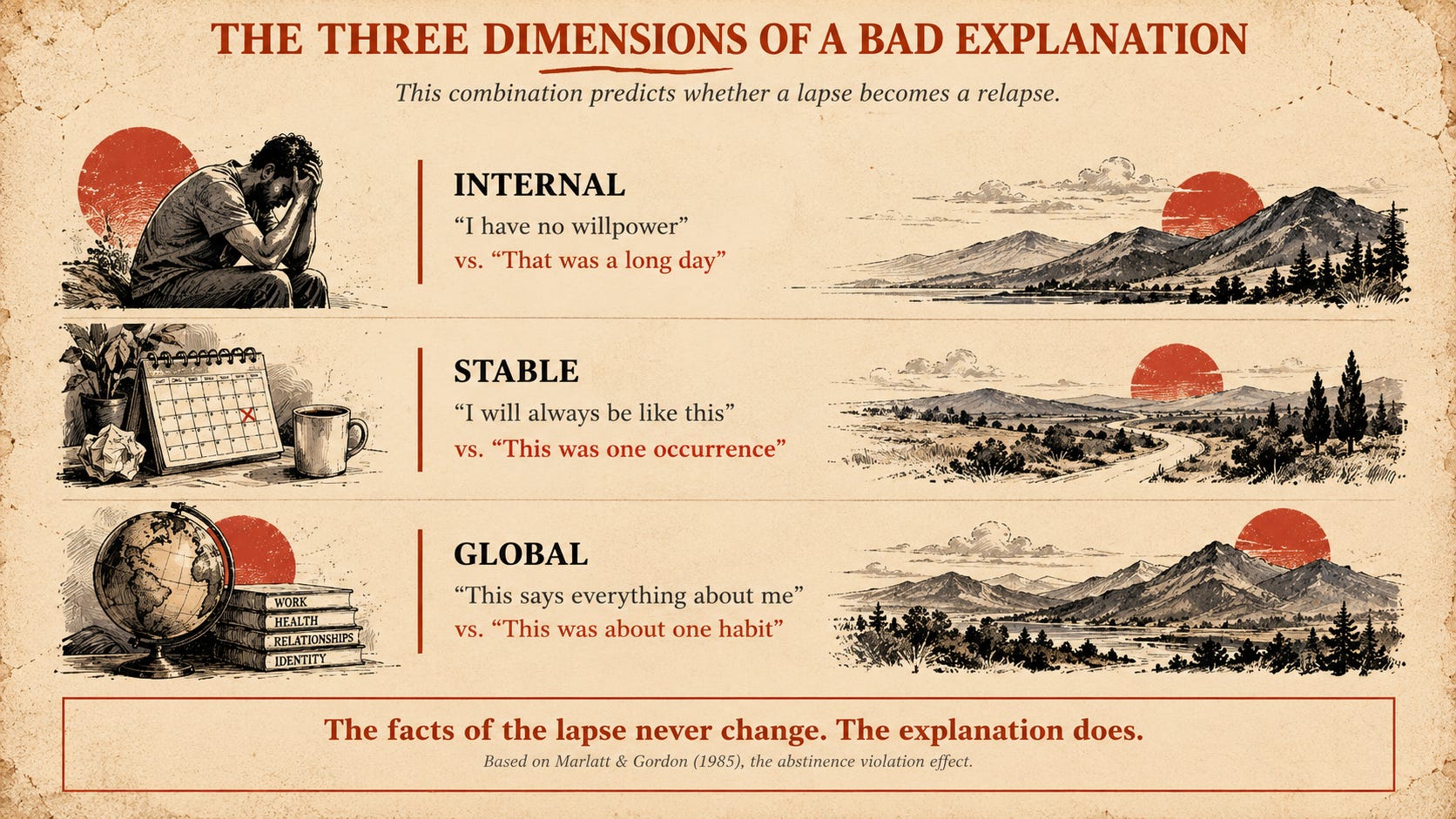
This specific combination of internal, stable, and global factors in the situation predicted if a person would make a onetime lapse into a complete goal abandonment. Susan Curry and two researchers later found that immediate attribution after a slip predicted whether smokers continued or resumed quitting. The researchers were measuring an attributional habit most people never consciously notice themselves forming, yet it predicted actual behavior weeks later.
One sentence after missing my run captured every element of the model without my realizing it. It was always doing this internal attribution was blaming some fixed trait rather than a long day. It was stable, treating the failure as permanent rather than because of circumstances. And it was global because this was never really about missing a run; it was a broad commentary on my character. It is no wonder that it was harder to get back into the habit for the next few days than it was to justify missing the run.
The value that this model brings over simply saying negative self-talk is bad is that the distinct elements of this model are specific. Not all self-criticism is broadly costly. Saying “running was a mistake, I will do better tomorrow” shows an internal attribution that is neither stable nor global, with research focusing on all elements combined rather than individually.
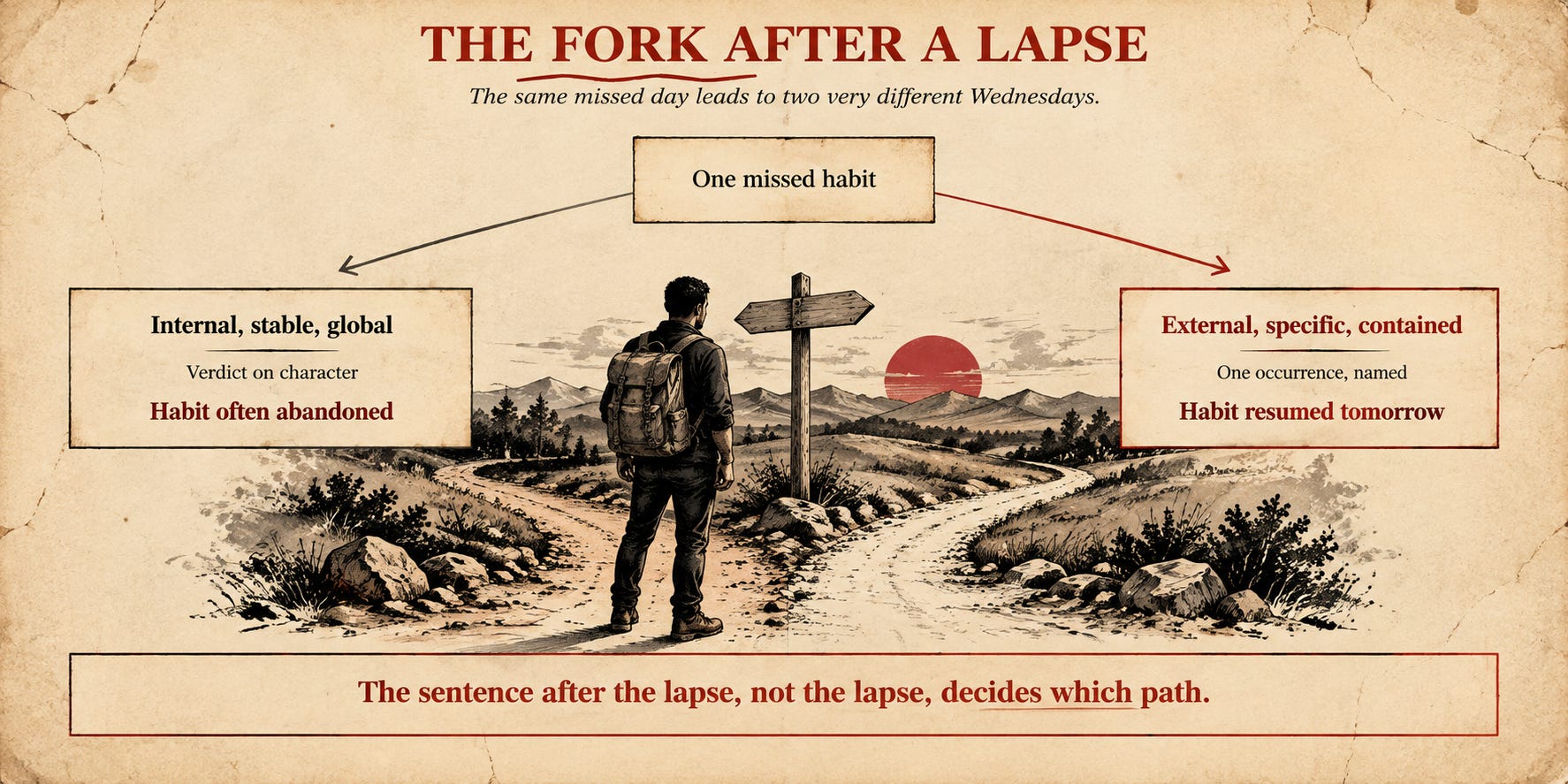
Research indicates that something more specific is being called for than just a generalized plea to be nicer to yourself. It is an improvement to the sentence itself, making it reach for a different one of the three dimensions. An external version explains the miss by reference to the actual circumstances (e.g., a long day), and not to a permanent trait of the self. A particular version contains failing to that one Tuesday and does not let it become a total verdict. The facts of the situation do not change at all. Only the explanation related to the facts changes, and Marlatt and Gordon suggest it is the explanation that is the deciding factor about what happens on Wednesday.
I have caught the sentence itself now, before it fully manifests. It still shows up from time to time, but now it doesn’t get to finish the way it used to, and many times, it doesn’t even fully get to state itself anymore. Direct naming of the three dimensions, often verbally, has proved a good antidote to the lazy, automatic tendency of the sentence.
The One Thing to Do Today
The next time you break a habit, write the sentence that follows it and reconstruct it to follow all three of the lines leading up to it before the day ends. Name the specific case rather than the trait. Treat it as an instance rather than a pattern. Restrict it to the case of that one habit rather than your character overall. Then return to the habit the next day as planned.
Go deeper with Borgella Street Journal.
Get full access to the Journal, including the print edition and subscriber benefits.