

I used to compare my willpower to a battery in which each charge spent before noon had to be replenished by the evening. At 9pm, if I had to have a difficult conversation, it was going to be as a weak 5pm me. It just made sense, and all the articles I’d read through the years on ego depletion reinforced my belief. However, after several years of research that I never expected to do, I came to understand that there was most likely no biological limit, and that my battery belief system may very well be doing all the work.
I never really looked at the metaphor closely because it fit my experience so well. A long, taxing morning really did result in a weaker afternoon, enough for me to believe in it. However, I never looked to see if thinking that I would hit a ceiling every afternoon affected the belief, because, more than likely, I went into every afternoon with that mindset.
If this changed how you think about it, the like button helps the next reader find it. Want to go further? Subscribe below.
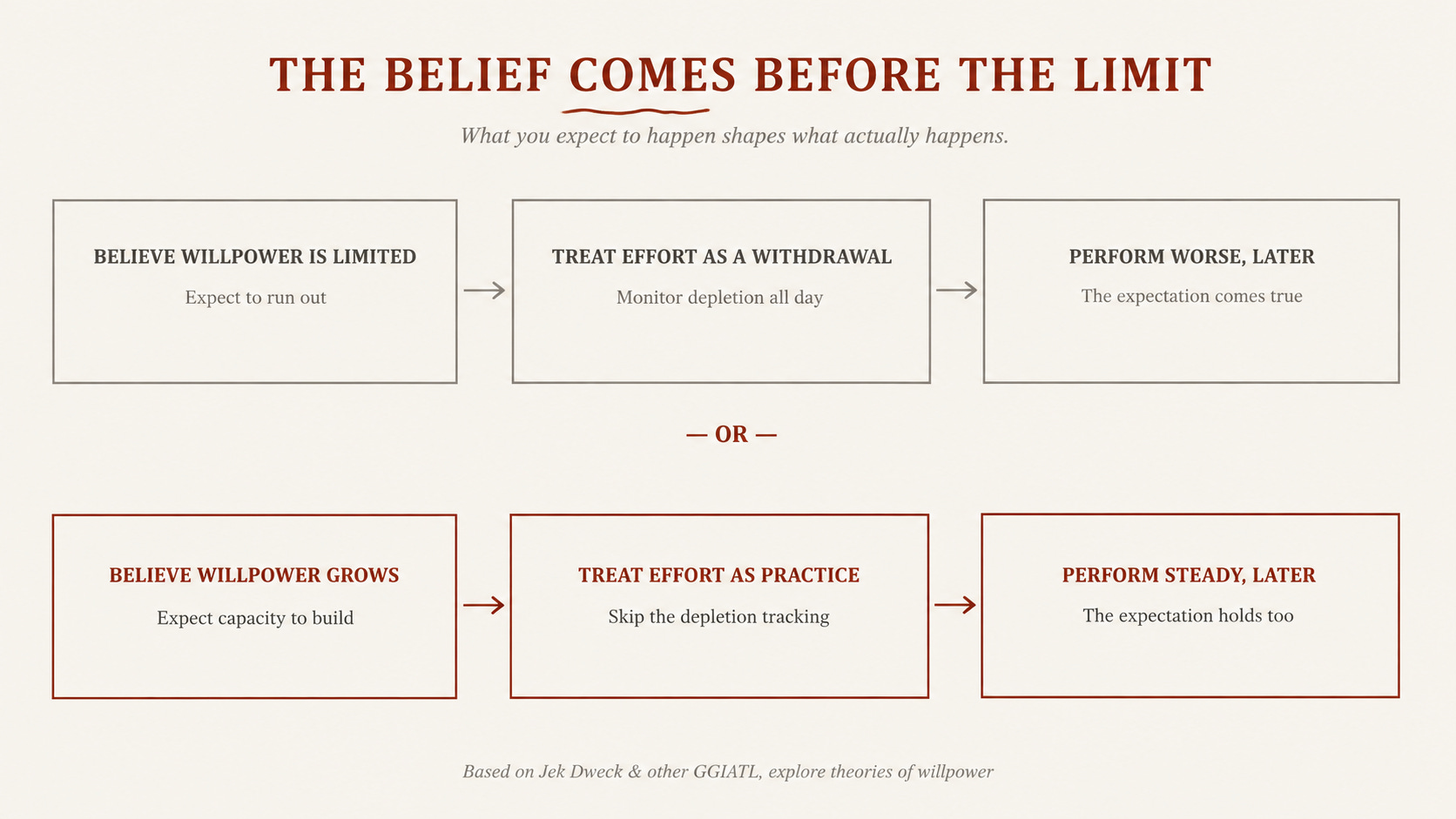
Psychologists Veronika Job, Carol Dweck, and Gregory Walton looked at the belief of willpower as a limited resource, and whether that belief actually frames the way people think. They found that a strong willpower limit theory exhibited the depletion effect, whereas a strong willpower no limit theory exhibited either non-existent depletion or very little depletion.
The primary goal of the researchers was to avoid the usual problem of determining whether one thing came before the other. Researchers employed a task involving reading to activate the belief of limitedness or unlimitedness prior to performing the task and had participants perform a depletion task in order to see if they could shift their theories. The performance gap showed, which further adds to the evidence of the function of the belief in the result, rather than it being a correlated trait.
Even with the abundance of newly found data, the researchers could not provide a solution to fatigue. This research examines the relation of hard tasks and decreased performance on the subsequent task. They found that a person is actively related to this process, rather than a biologically fixed ceiling that will run out. It has been the case that the belief of willpower depletion is rapid, and it has also been the case that the belief of willpower depletion is not rapid.
Albert Bandura studied self-efficacy, the belief in one’s ability to successfully carry out a task, for many decades. He studied how a person views the effort they expended, as well as how they persevered while completing a task that required a high level of difficulty. Self-efficacy was correlated with one’s overall ability. The two individuals with varying self-efficacy and the same ability would exhibit very different behaviors while performing a hard task was difficult.
Bandura looked at the different sources of efficacy, and in building self-efficacy, these sources are very important. One of Bandura’s descriptions is “mastery experience.” This is when a person accomplishes a particular task and is the most important of the three cases. The person whose belief is challenged by someone who views an evening that was spent working as the end of their ability is making a very poor “mastery experience.” This is in the person’s best interest.
If this is a pattern you have lived through yourself, say so below. The comment that describes it best usually helps the next reader more than anything I could add.
Both Bandura’s and Job’s work describe the same underlying structure from two different angles. Job’s work analyzes the differing individual beliefs about the resource, if individuals think the resource diminishes or is constant. Bandura’s work analyzes individual beliefs about the task, if people think they can complete the task. Both beliefs influence the behavior even before any limitations are put on the behavior.
Dweck’s work is concerned with the individual’s belief regarding the malleability of ability. Dweck describes the fixed mindset as the belief that a person has a denoted trait. Dweck believes that by exerting effort, one can grow and develop. This study found that students who possessed the belief that they could grow, in fact, performed better when faced with challenges, by utilizing more advanced techniques and exerting more effort. If you hold the belief that your talents are fixed, a hard morning is the extent of your ability. On the other hand, if you believe you can grow, a hard morning is a mere setback.
Dweck’s research has been examined outside of students. After being told they were intelligent, participants of a different successful task left simpler following tasks to protect their intelligence. Whereas those told they showed effort completed more difficult following tasks. For them, their effort could easily be prolonged unlike intelligence. Praise affected how people perceived the difficulty of the task.
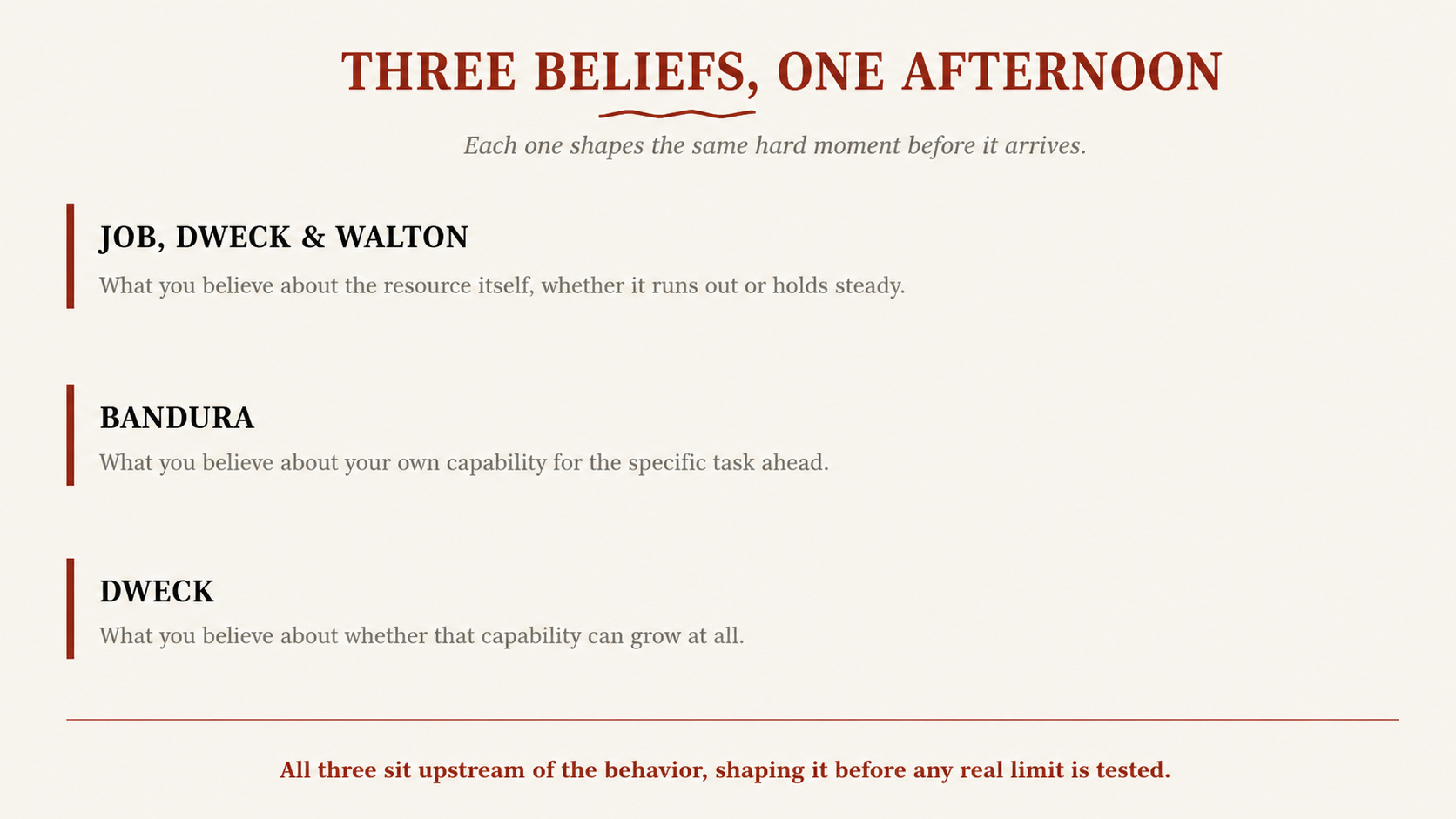
These three areas of research pull together more than a single finding. A person’s belief surrounding their willpower as a resource, whether they can perform a task, and how they perceive the mutability of their capability and yes, their improvement, all weave together mysterious, unpredictable strands, the afternoon prior to its arrival. None of these researchers, by any means, intended to describe or provide a way to alleviate the taboo of ‘Hard Tuesdays’. Their findings demonstrate why a given routine or schedule is perceived differently based on a person’s belief system.
Locally, a positive shift in attitude towards the day can be paired with something more tangible. In the past, the 9 o’clock ‘decision’ would arbitrarily limit post-work activities. Suboptimal events that occur early in the day are now viewed as part of the process of executing a specific task rather than an absolute constraint. Before, I used to direct effort and energy into the physically exhausting task of guesstimating my level of fatigue. Now, I direct effort and energy toward a more important and valuable task, as opposed to the vacant afternoons I used to have.
The previously unseen changes happened at the beginning of the day. There used to be something, a tough phone call that marked the end of my work/school day. Now I think of it as something I need to do that day. The call itself has not magically become easier. I used to think there was nothing I could do to change the outcome of my day since I believed the call decided it. What used to decide the end of my day was a belief that used to exist, but never was confirmed.
What previously concluded my day now only encompasses the beliefs I have about myself. Previously, my day would end with the evening research I would do on myself. I used to think I had limits and small batteries that would decline after a challenging conversation or decision. After conducting research on myself, I would consider my afternoons defeated before they even began. I decided I would no longer believe that my own limits were self-truths.
The One Thing to Do Today
Note the first time you tell yourself, “I’m already too drained for this today” and substitute it for a belief to test instead of a fact to accept. Then do the next hard thing to see if you still feel drained as the statement describes.
If this piece opens the conversation on how discipline actually works day to day. The paid essays at Deliberate Project go further into the research and the systems behind it, one piece at a time.
Have advice, a letter, or a suggestion for us? Send it to kanpoteau@gmail.com.
See you next time,
The Deliberate Project Team
References
1. Job, Veronika, Carol S. Dweck, and Gregory M. Walton. “Ego Depletion: Is It All in Your Head? Implicit Theories About Willpower Affect Self-Regulation.” Psychological Science, 2010.
2. Bandura, Albert. “Self Efficacy: Toward a Unifying Theory of Behavioral Change.” Psychological Review, 1977.
3. Dweck, Carol S. “Mindset: The New Psychology of Success.” Random House, 2006.