

Why Calm Leaders Aren’t Naturally Calm
By: Pierre Poteau
I was once a leader who held titles that gave me the unfortunate responsibility to perform a job that would earn the record for bad meetings of the week. As I ended up becoming one of the unwilling participants in his exit meetings budgeting calamity, as he broke the bank and sat them down on one-way tickets to unemployment, I witnessed a former boss perfect his science. One employee dared to inform my manager that we had made a mistake, and a client was going to jump ship over the insult we inflicted. My manager simply took notes and then posed two additional inquiries. It wasn’t until a few years later that I discovered this wasn’t just his disposition. I realized that his composure had a method and a system that turned out to be 3 specific behaviors that people aren’t born with.
It took almost two years of observation to see that none of the three things he did were habits of a leader. It was not until I had a horrendous week of witnessing him remain composed while all 3 major stressors occurred on four consecutive days that I could decipher how he was calm off the job. I would say his composure was likely a direct result of his meeting style and how things fell apart.
Most writing on habits focuses on describing the problem. This essay will fill that gap by addressing all three facets of the problem. For most people, composure is a trait. That isn’t the feedback a reader can use. A system changes behavior, and the components of the system that are the focus of this essay are very specific. So instead of something to admire, this is something to try this week.
If this is a pattern you have lived through yourself, say so below. The comment that describes it best usually helps the next reader more than anything I could add.
The First Habit: Protect the Reserve Before It Gets Spent
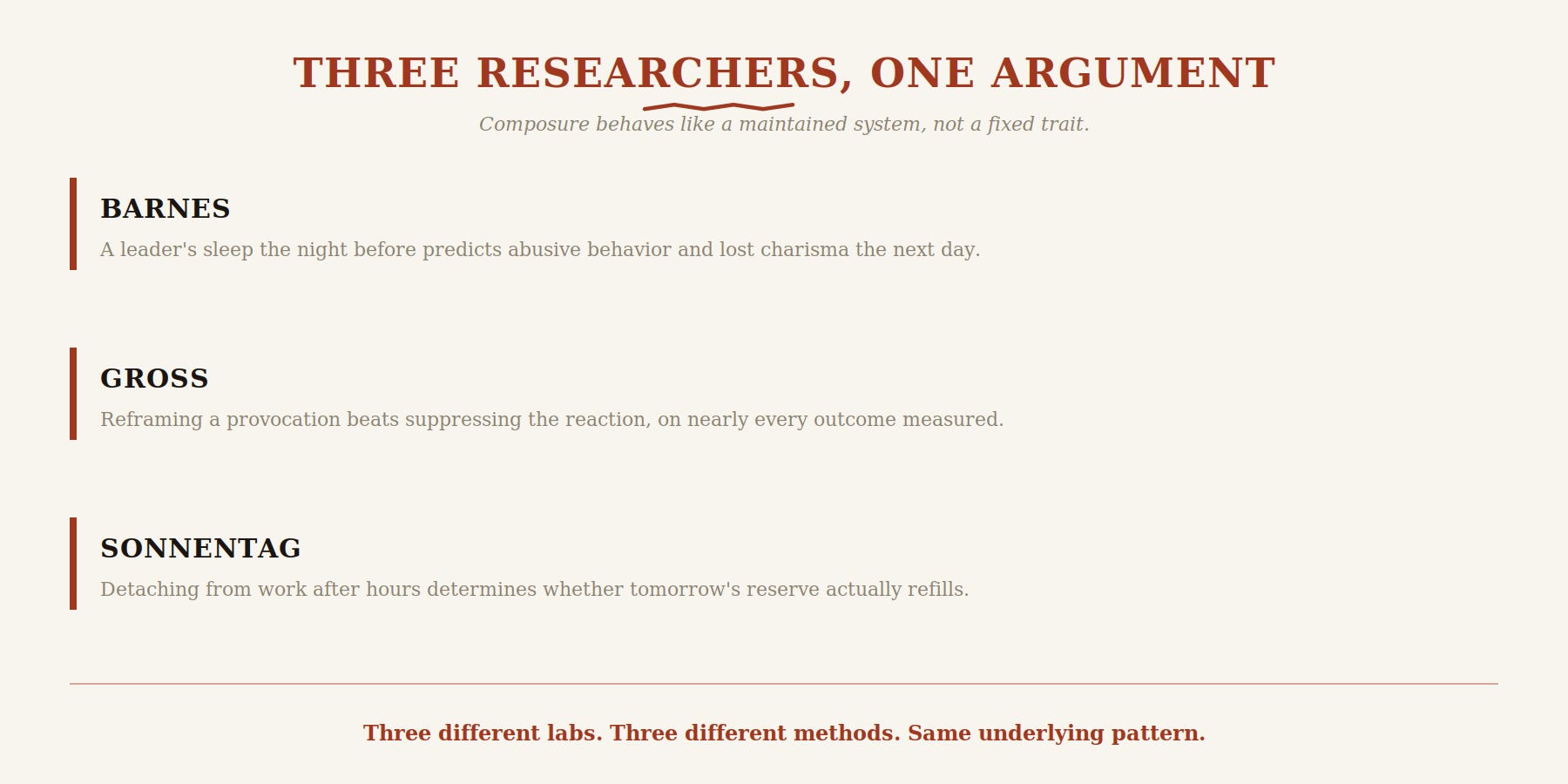
There was a study by Christopher Barnes of the University of Washington that looked at the sleep and the reports of supervisors’ negative behavior by the employees. The pattern of the sample was that the people who reported to the supervisors the next day identified them as more abusive supervisors. The pattern showed a substantial effect on the supervisor's self-control. Being tired doesn’t make someone grumpy in some ethereal way, like many people think. Self-control is the energy that is most needed in challenging situations.
The same researchers also found that when there were no complications, groups perceived sleep-deprived leaders as less charismatic. This was not because of poor ideas, but an inability to generate them. Some say flatness signals a lack of interest, meaning one poor night of sleep would cause a leader to lose both standing and credibility, even on a day of work that will probably have no difficult meetings to run.
Sleep used to be one of my boss’s constraints, so he scheduled meetings around it. He would even protect it as he would a client's deadline. He ran out of energy by 3 PM. This is not about “taking care of yourself,” it is more specific. The energy a person uses for a challenging work conversation drains the night before, not during the conversation. So, if we look at sleep as something we have control over, we automatically influence the next day’s equilibrium.
The Second Habit: Reframe Instead of Suppress
James Gross, as a Stanford psychologist, specializes in how people adapt to and manage complex feelings. Gross, among others, labels these processes as reappraisal or suppression. Suppression, in contrast to reappraisal, refers to attempts by individuals to shield or mask their emotions and to control their emotional outbursts by maintaining composed behavior. Regarding compensatory processes, individuals use reappraisal. In such a process, people refrain from making a judgment on an occurrence or an event. A reappraisal example is to interpret an aggressive comment as a reflection of the author being under a lot of pressure to defend their right to comment. When comparing reappraisal and suppression across many measurements, reappraisal consistently shows positive outcomes. Compared to suppression, reappraisal produces higher levels of well-being and a lower physiological stress response, and strengthens the relationships of those in the room.
The Third Habit: Actually Leave Work at Work
Sabine Sonnentag, who researches the recovery from work stress at the University of Mannheim, has shown over many years what most leaders view as a luxury. Researchers have shown that leaving work at work aids recovery and conserves energy. People who work on problems after hours experience increased stress and depleted energy for the following workday.
This is the habit most leaders forgo. Sin’s research shows that ‘one more email’ at 9 PM actually depletes energy and composure for the following workday. This results in a false sense of completing work ‘responsibility’ for the day. This actually creates a workplace deficit, showing up the next day. My old manager was unique (he actually phoned from another room) in that this habit was much like his other two habits.
System, complete
These three habits are not three tips competing for your attention. This practice builds a reservoir of energy to combat a stressful workday. Preventing work from occupying the space and time formerly reserved for sleep determines how much energy a leader possesses at the start of the day. Practicing recovery for a moment afterward determines how much of that reservoir depletes. Detachment or leaving work at work actually determines if the energy reservoir depletes or refills.
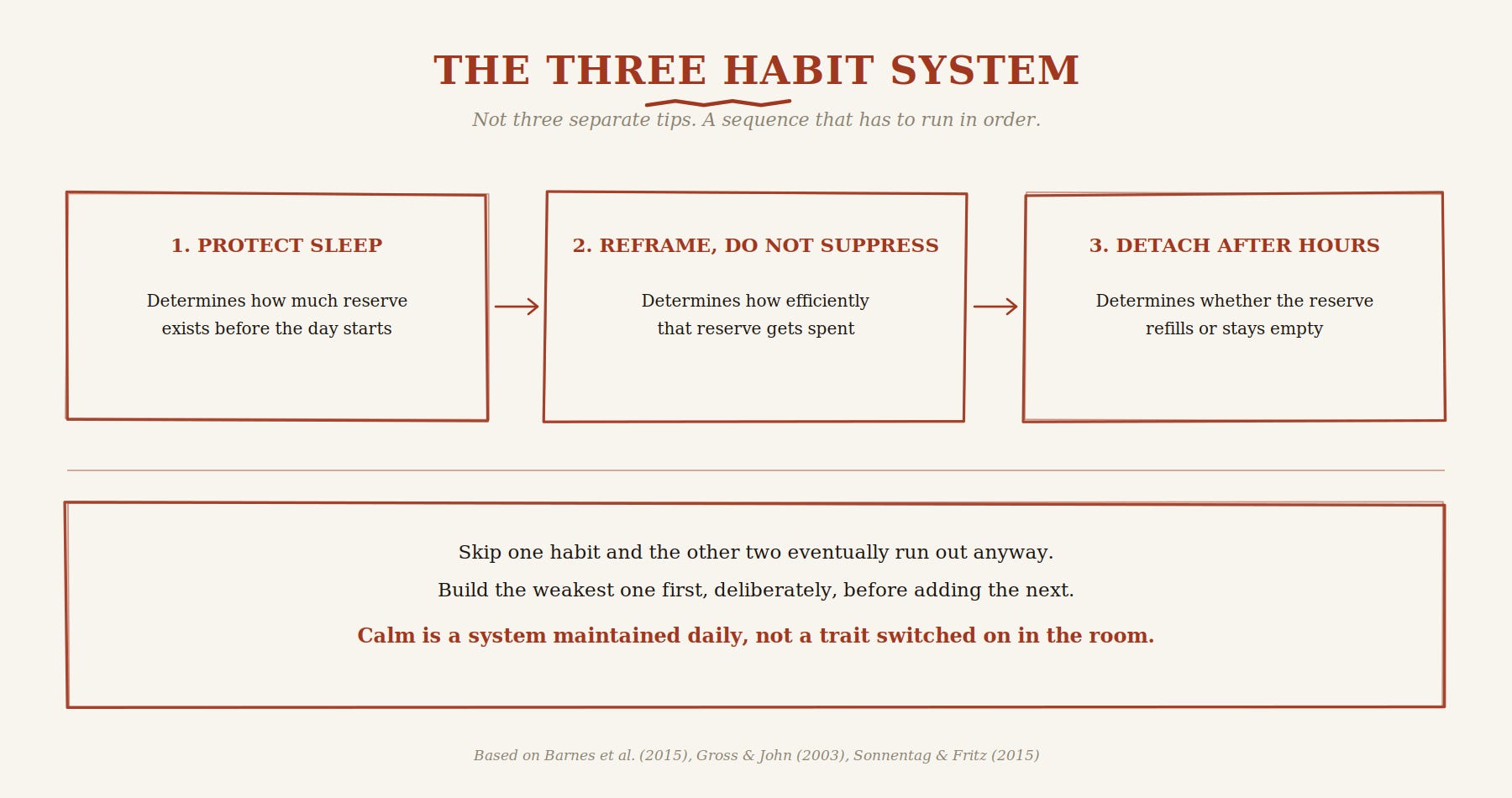
Figure 2. The three-habit system and why it doesn’t work the other way around.
This isn’t about having the correct personality, which is where most leadership advice goes astray. It’s about meeting my bedtime, changing how I respond to annoying people to thinking of those as no response at all, and creating a nighttime practice. My ex-boss would not consider himself a calm person. He probably wouldn’t have phrased it this way, but he would have said that he would not go into a ‘hard room’ after he completely drained himself.
The One Thing To Do Today
Which of the three habits (sleep, reframing, and detaching) is the most challenging for you? Work on that habit this week prior to your other challenging meetings. Do not work on all three habits at the same time. Focus on that which costs you the most, and then the other two can come after.
This first Deliberate Project essay is going to examine the subtlety of these steps of leadership. The paid essays explore the research and systems in more detail, focusing on each aspect separately.
If this changed how you think about it, the like button helps the next reader find it. Want to go further? Subscribe below.
Have advice, a letter, or a suggestion for us? Send it to kanpoteau@gmail.com.
See you next time,
The Deliberate Project Team
References
1. Barnes, Christopher M., Lorenzo Lucianetti, Devasheesh P. Bhave, and Michael S. Christian. “’You Wouldn’t Like Me When I’m Sleepy’: Leaders’ Sleep, Daily Abusive Supervision, and Work Unit Engagement.” Academy of Management Journal, 2015.
2. Gross, James J., and Oliver P. John. “Individual Differences in Two Emotion Regulation Processes: Implications for Affect, Relationships, and Well-Being.” Journal of Personality and Social Psychology, 2003.
3. Sonnentag, Sabine, and Charlotte Fritz. “Recovery from Job Stress: The Stressor-Detachment Model as an Integrative Framework.” Journal of Organizational Behavior, 2015.