

Discipline research is largely concerned with absenteeism. A less well-known yet more technically challenging strand of literature asks an interesting and more constructive question. What do people actually accomplish in the hours that they have committed to developing a particular skill? That second question actually yields a hardly surprising answer that is both very specific and particularly more controversial.

I. The Violinists Who Redefined Expertise
In 1993, Anders Ericsson and his colleagues published a study that changed how people thought about skill and influenced a generation. Along with the Music Academy of West Berlin, they recruited three groups of violin students: an elite group who alone among faculty would likely become famous soloists; a solid group who would most likely have successful, but less distinguished, careers; and a group headed toward music education. A fourth group of professional violinists (mature amateurs) was recruited to test how the pattern among the students might be apparent for adults who have had a career with the violin.
The researchers asked the violinists to estimate, as best they could, the number of hours spent on private practice for each year of their lives since they started playing. This was a complex task for the participants, and some violinists needed to remember at least ten years of practice, which is worth noting for later reasons. According to the researchers, the violinists in the top division of the competition had practiced on their own for about 7410 hours by the time they were 18 years old, compared to the 3420 hours of the violinists who wanted to become teachers. The researchers noted that this difference was statistically significant (F(1,27) = 11.86, p < .01). In a diary study that was done later, the participants were asked to fill in a detailed week of practice. For this week, the best and good violinists spent on average 24.3 hours practicing, while the violinists in the education division practiced on average 9.3 hours.
These numbers, especially the fact that the elite group had accumulated roughly 10,000 hours by age 20, have influenced one of the most frequently cited statistics in pop-science writing on expertise. The most general version of the assertion is that one can achieve mastery in any domain through 10,000 hours of practice. This formulation of the claim made accumulating skill a simple arithmetic problem. Later, Ericsson resisted this interpretation in public, stating that the most commonly cited version of his work was false, and that this claim was the tip of the iceberg of misrepresentations. Most importantly, the hours in his data were never the mechanism of interest. They were the byproduct of something else.
II. What Deliberate Actually Means
The distinction Ericsson draws between his own findings and their subsequent death by a thousand cuts comes down to the single word where his paper goes to great lengths to define. For Ericsson, as opposed to the repetition of an activity, deliberate practice is a particular goal-directed practice supported by a coach or a clear external standard, accompanied by rapid, frequent feedback, with an intensity that differentiates it from everyday work and leisure. He described this category of practice as a deliberate form of intense practice in contrast to the hundreds of thousands of repetitions, which, according to him, could go on for years at an acceptable level of performance without leading to any substantial growth.
The hours were never the mechanism. They were the byproduct of a specific, narrow kind of effort most practice never actually reaches.
This distinction is important because it alters how the violinist's data should be interpreted. The top violinists did not just accumulate more total hours in proximity to their instruments. They accumulated more time in a practice mode comprising structure, feedback, and hard effort at the upper limit of their capabilities. This mode is effortful and is not enjoyable to the participants, contrary to activities like performing or playing music for one’s pleasure. Someone who practices for three hours in a state of comfort and repetition is not doing the same activity as someone who practices for three hours in a state of struggle and intending to receive feedback.
This gap was eliminated in the findings that gained popularity. Once a number is plucked from its original context, repeated in books and articles many times over, it loses the context and qualitative meaning it once had. Ten thousand hours became a goal to be achieved rather than a description of an extremely difficult and time-consuming activity, which was when done over a period of many years. This distinction was present in Ericsson’s writing. It just disappeared after the writing was passed along.
The 1993 study has undergone considerable methodological criticism in the decades following its publication. I believe these issues can best be addressed by discussing the original numbers, as opposed to considering the study as beyond criticism. The practice estimates relied on retrospective recall in some cases, which extended beyond 10 years. This method is highly subjective and has yet to be controlled for in the original study. A 2019 study using a double-blind methodology and more advanced statistics found a smaller and more complicated relationship between practice and skill level when compared to the original study. This study, unlike the original study, was able to demonstrate a statistically significant relationship. From a research perspective, the original study was sound and well executed, and the main finding of structured feedback and practice was supported and validated. The main finding is that there is a positive relationship between deliberate practice and improvement in skill level.
III. How Much Practice Actually Explains
The original violinist study was limited to just one domain and had a very small sample. It was never able to address how much of the difference between more and less skilled performers deliberate practice would account for once the finding was examined across many domains and many independent studies. This was the focus of a 2014 meta-analysis by Brooke Macnamara, David Hambrick, and Frederick Oswald. Pooling all available research, the team found that deliberate practice accounted for 26 % of variance in performance for games, 21 percent for music, 18 percent for sports, 4 % for education, and less than 1 percent for professions.
Additional analysis of sports indicated the greatest amount of interest in a particular area for those who are not concerned with merely reaching a baseline of competence. Deliberate practice accounted for 18% of the variance in overall sports performance, but only 1% of the variance in elite-level performers. This confounding finding actually supports the original violinist study and the subsequent real-world examples; they focus on explaining elite-level performers, for whom deliberate practice accounts for only 1% of performance variance. Among other elite performers, the remaining variance is attributed to factors that are beyond those captured by deliberate practice, such as starting age, working memory, and genetic factors of relevant skills.
The elite-level performer statistic deserves careful consideration, unlike others, because it focuses on the population for which the 10,000-hour rule was developed . No one peddling the mass-market version of Ericsson’s studies sold the rule to hobbyists or casual learners. The rule, as the general population adopted it, stated that a particular number of practice hours would ensure that one would become a top performer in a given field. The criticisms, based on the meta-research, are most directly and unfavorably aimed at this statement.
Structured practice driven by feedback is necessary for skill development in every single domain that was investigated. The type of practice that Ericsson described is necessary for skill development in every single domain that was investigated, and the difference between that and repetition is real and should not be ignored. What the meta-analytic data suggests is that the claim that practice (in everything else that may affect performance) will close the gap saliently to the level of elite performance is false. Informed commentary based on all the data available suggests that deliberate practice is an important, controllable element amongst the other elements of performance and is a more restrained and honest assertion compared to the interpretation of this data that made its way into the public domain.
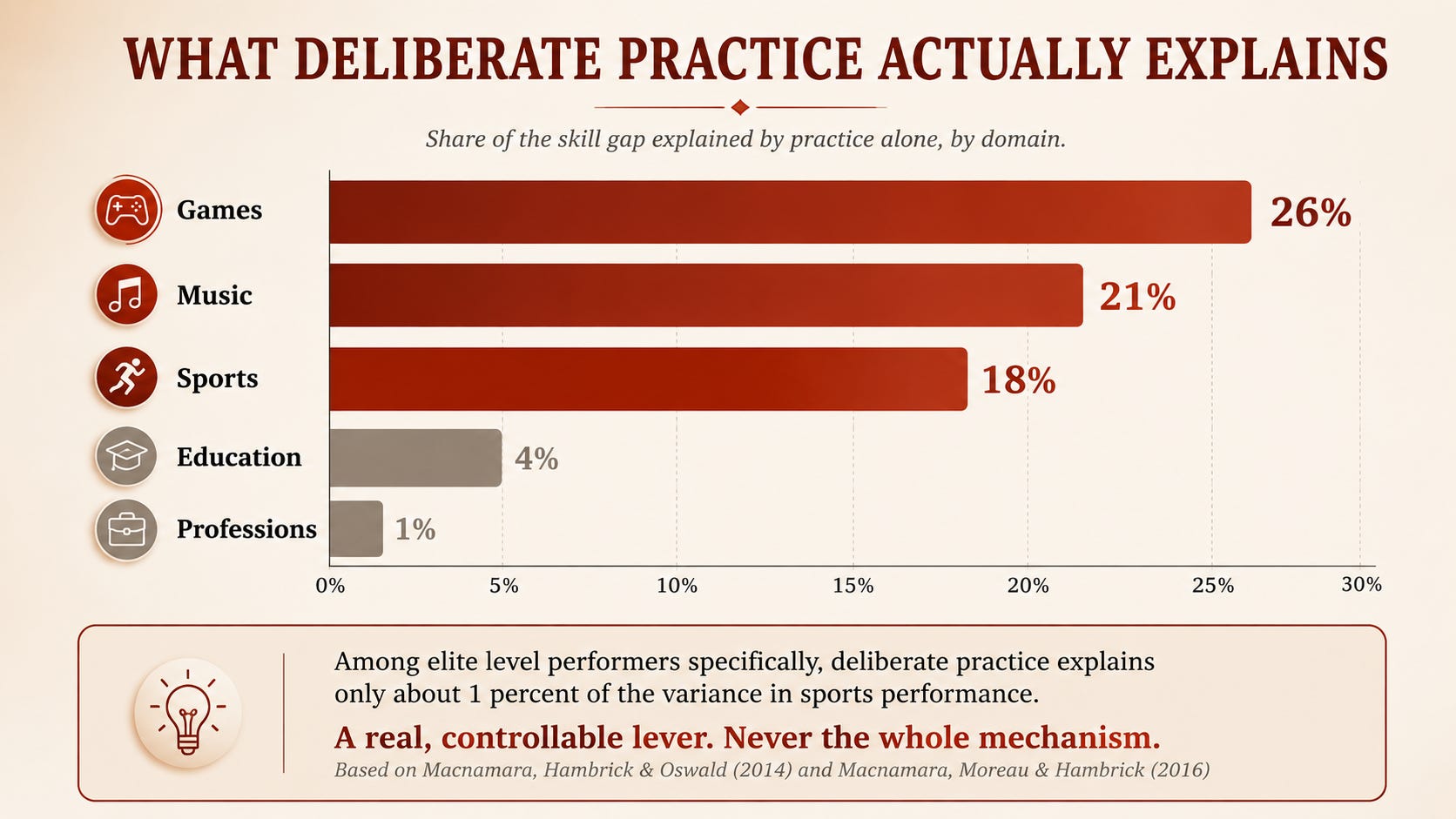
Figure 1. What deliberate practice actually explains, by domain, and why elite performance narrows the claim further.
IV. The Practical Lever That Still Holds Up
If total hours alone explain less than the popular story claims, then the more specific question of which practice structures carry the most well-replicated benefit becomes important. For timing, one of the clearer answers from the learning of science literature exists. A 2006 meta-analysis by Nicholas Cepeda, Harold Pashler, Edward Vul, John Wixted, and Doug Rohrer, examined what happens when the same total amount of practice is spread across spaced practice sessions, as opposed to being concentrated within a single, massed practice session.
The spacing effect is one of the most well-known and well-replicated findings in the learning sciences. This effect is the same for verbal recall tasks, for learned motor skills, and for the subject taught in class. In comparison to the other findings in behavioral science, few findings have been replicated as much. More recently, a 2025 meta-analysis on classroom studies found a moderate effect of distributed practice over massed practice (d = 0.12), with a 95 % confidence interval of 0.31 to 0.77, from 31 effect sizes across 22 studies that included 3,000 participants. Zero.
What is useful about this finding for those wishing to create a practice system is how independent this finding is of the most worked-over portions of the literature on deliberate practice. The spacing effect does not hinge on the resolution of the debate regarding how much of elite performance practice explains. It has been independently replicated as a finding regarding how the same quantity of practice time is allocated across a calendar, which is completely within the individual’s control irrespective of what other factors determine the maximum skill level that can be attained.
The spacing effect seems to involve retrieval rather than exposure. Practice of a skill or fact after some period of forgetting requires the brain to actively reconstruct the fact or skill rather than recognize it, as would be the case if it were still in short-term memory. Using this mechanism, cramming often does produce strong (say, exam) performance quickly, but the material is forgotten very rapidly (say, the next week). This effect has been extensively documented in the spacing effect literature across a wide variety of materials.
The same total hours, spaced differently, produced a measurably different outcome. The clock's time never changed. The schedule did.
V. Building a System From What Survives
Putting what has been critically examined together gives a stronger, more defensible version of the system than the ten-thousand-hour rule ever has. Structure plays a role over the total time per Cepeda and colleagues and more recent classroom-specific evidence, timing and practice distribution that produces a benefit that is almost practice duration independent. Long practice sessions over a period of time only explain a small amount of the performance and talented performers come from deliberate practice and effort over a long period of time, and people who are already highly skilled require less practice to perform than the general population. This implies that practice time is not a guarantee of improvement and that there is no absolute number of hours required for performance.
Building an effective practice system from this evidence asks three critical questions before practicing, rather than adding the time afterwards. Is there an external standard for this practice session? Is this practice session delivering real-time feedback and not practice sessions that are done in isolation without the ability to provide feedback? Finally, has enough time elapsed since the previous practice session for some forgetting to occur? This does not mean it is good practice to schedule the next session of this same practice too soon. Rather, abandon rehearsed material and practice from short-term memory.
These three questions address both sides of the research discussed here and will be addressed simultaneously. The first two questions are about Ericsson’s original definition of deliberate practice, focusing more on structure and feedback, rather than sheer repetition. The third question considers the spacing effect; the only part of this research that has something to offer, despite the unresolved debate about how much practice ultimately counts. If a practice session answers negatively to all three questions, it probably should not be considered a wasted practice; however, it should be placed into a different category than the practice both research bodies studied. Expecting similar results is a comparison that the existing research will not justify.
This does not guarantee that structured, well-spaced practice will generate elite performance, since the systematic evidence contradicts this, especially for competitors who are already at the top of their respective fields. What it will give is a more realistic goal and is more useful, control of the approximately one fifth to one quarter of the gap that deliberate, well structured, appropriately spaced practice seems to have a reliable impact on, rather than control of a gap that, based on the other evidence, seems to be affected by numerous other factors besides effort.
The One Thing to Do Today
Take one practice skill and practice that exact skill for 3 weeks with 3 shorter sessions, each including deliberate practice and opportunities for immediate feedback related to a specific practice standard. Sessions should be scheduled enough to allow previous practice sessions to be forgotten.
Have advice, a letter, or a suggestion for us? Send it to kanpoteau@gmail.com.
This piece is part of an ongoing series on how skill and discipline actually get built, drawn from the same research, including the parts that complicate the popular version of the story, that shapes everything published here at Deliberate Project.
See you next time,
The Deliberate Project Team
References
1. Ericsson, K. Anders, Ralf Th. Krampe, and Clemens Tesch Romer. “The Role of Deliberate Practice in the Acquisition of Expert Performance.” Psychological Review, 1993.
2. Macnamara, Brooke N., David Z. Hambrick, and Frederick L. Oswald. “Deliberate Practice and Performance in Music, Games, Sports, Education, and Professions: A Meta Analysis.” Psychological Science, 2014.
3. Macnamara, Brooke N., David Moreau, and David Z. Hambrick. “The Relationship Between Deliberate Practice and Performance in Sports: A Meta Analysis.” Perspectives on Psychological Science, 2016.
4. Cepeda, Nicholas J., Harold Pashler, Edward Vul, John T. Wixted, and Doug Rohrer. “Distributed Practice in Verbal Recall Tasks: A Review and Quantitative Synthesis.” Psychological Bulletin, 2006.
5. Mawson, Rhys D., and Sean H. K. Kang. “The Distributed Practice Effect on Classroom Learning: A Meta Analytic Review of Applied Research.” Behavioral Sciences, 2025.
If this is a pattern you have lived through yourself, say so below. The comment that describes it best usually helps the next reader more than anything I could add.