

I’ve thought of myself as a disciplined person, like some people do with their star signs. Then there was the planner on my desk that I opened even more seldom. I tried so many things to improve my life, one of them being the purchase of a gym membership and preparing a week’s worth of meals. I badly wanted to be consistent with my habit tracker, but I wasn’t. I previously believed these actions represented discipline, but I now understand that I simply liked the idea of discipline, which reduced my satisfaction in believing I was disciplined.
My friend at dinner noted my lack of regular runs, and while I tried to recall my last one as recent, I had actually quit running. I was reporting a significant change in the identity of who I was last when I ran.
This is probably relevant to most people, but very few vocalize it. Many see discipline as a feeling needed for action, leading to waiting. This feeling is inconsistent, causing systems to fail for some. The surprising part of it all is the lack of people questioning the system. Most people think it is only a matter of time before that feeling shows up.
If this is a pattern you have lived through yourself, say so below. The comment that describes it best usually helps the next reader more than anything I could add.
Studying this gap has helped me a lot, and it took me far too long to actually put his studies to use. Baumeister studied discipline throughout the day, and one of the early studies is actually quite amusing. Baumeister placed people in a room with a plate of cookies and a bowl of radishes and told the participants they could only have the radishes. He then gave each participant a puzzle that was unsolvable. The people who had just spent their willpower resisting the cookies gave up on the puzzle far sooner than the people who got to eat whatever they wanted.
This is still a controversial field. I cannot claim that the controversy is over because it clearly continues. I think some of the simpler versions of self-control theory are likely to have some longevity. Some have argued that self-control is not a trait that remains at constant levels. It can certainly vary. The number of decisions one has made, how tired one is, and even how much one has slept can also relate to it. In fact, my 7 am self and my 9 pm self are not the same in keeping a promise. I thought they were the same. I actually think Mischel’s work provides the solution to self-control more than Baumeister’s. This was a surprising new finding for me as I undertook this work. Mischel's Marshmallow experiments offered children one treat immediately or two if they waited, which I assumed measured early willpower. In fact, this was not at all the case.
Later researchers challenged these findings, and this remains a point of contention in the field. I can’t say people have settled this debate because they have not. I think simpler versions of the self-control theory will have some staying power. Some say that self-control is not always present, nor is it always to the same extent. It can fluctuate. Whether you have made many previous decisions, how tired you are, and even how much you have slept can affect it.
If this changed how you think about it, the like button helps the next reader find it. Want to go further? Subscribe below.
My 7am self and my 9pm self are not the same to keep a promise. I made a mistake in thinking that they were the same person. I would say that the actual solution, or fix, to self-control was more in Mischel’s work as opposed to Baumeister’s, and this was a surprise to me the first time I did this work. Mischel’s famous Marshmallow experiments involved children. Mischel left the children in a room with one treat and told them they would receive two treats if they waited. I had assumed this experiment was measuring to some extent internal steel, willpower that is present early and neatly captures the rest of the story. This is not the case at all.
He filmed the kids and found that the kids who waited were not gritting their teeth through the temptation. They managed where their attention landed. They avoided eye contact. They hummed. One even tried to rest. These kids weren’t even resisting the marshmallow test. This behavior came from learning.
It was a Tuesday, around early afternoon. I was sitting at my kitchen table. I was that person with no shame who wrote a whole paragraph about themselves. I have had this belief for many years that my problem was a lack of the internal resources everyone else has. I could not see the answer as the thing I was looking at, something as simple as that.
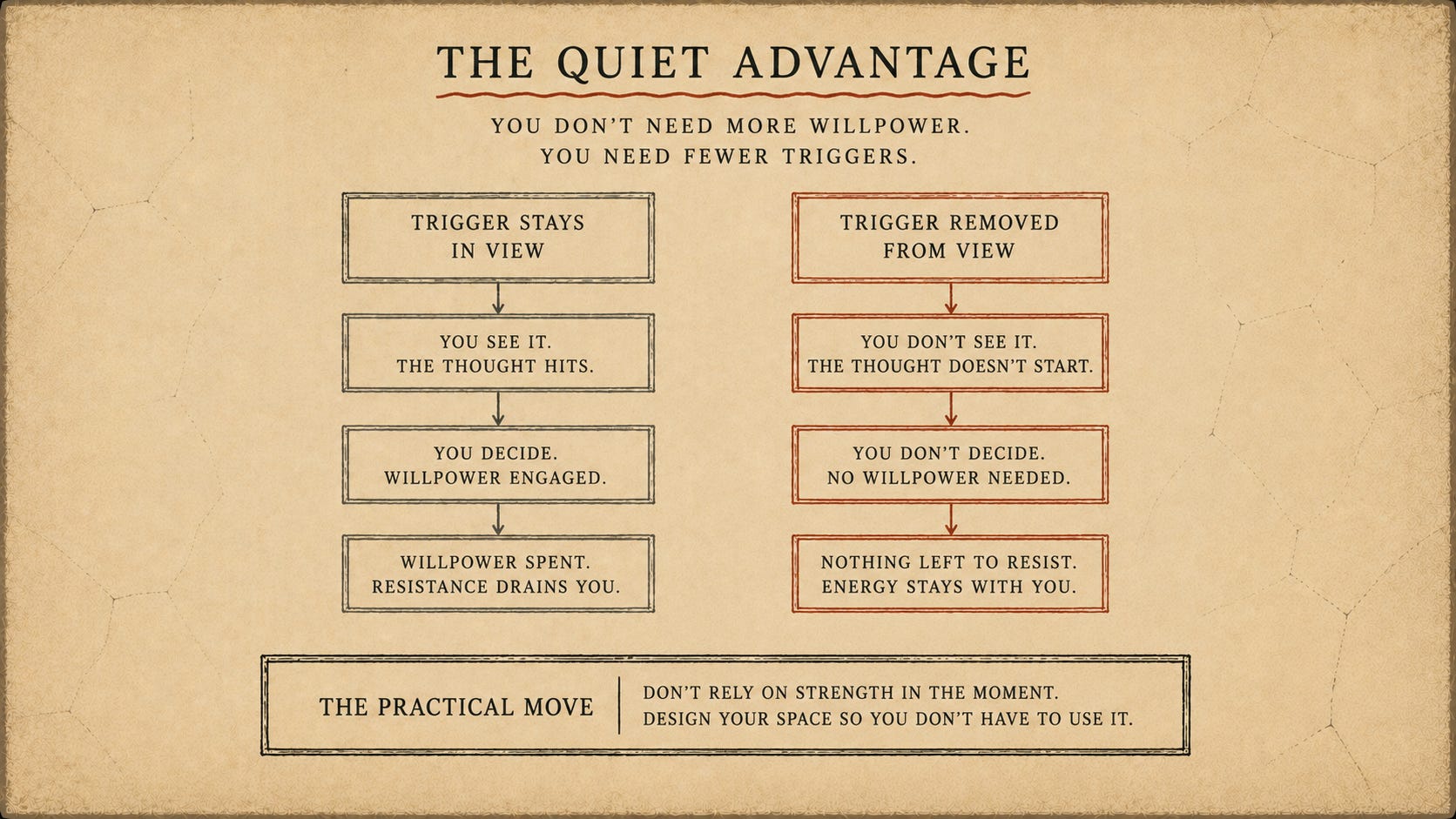
This reframing really helped me out. I stopped asking, why do I not have the willpower? I have been asking the right question for much longer; what do I look at right before I break my promise to myself? For me, it was always putting my phone face up on the desk for rest periods during my writing sessions. As far as willpower is concerned, I’m not checking my phone during my breaks. For the next year, I’ll just hang onto that solution.
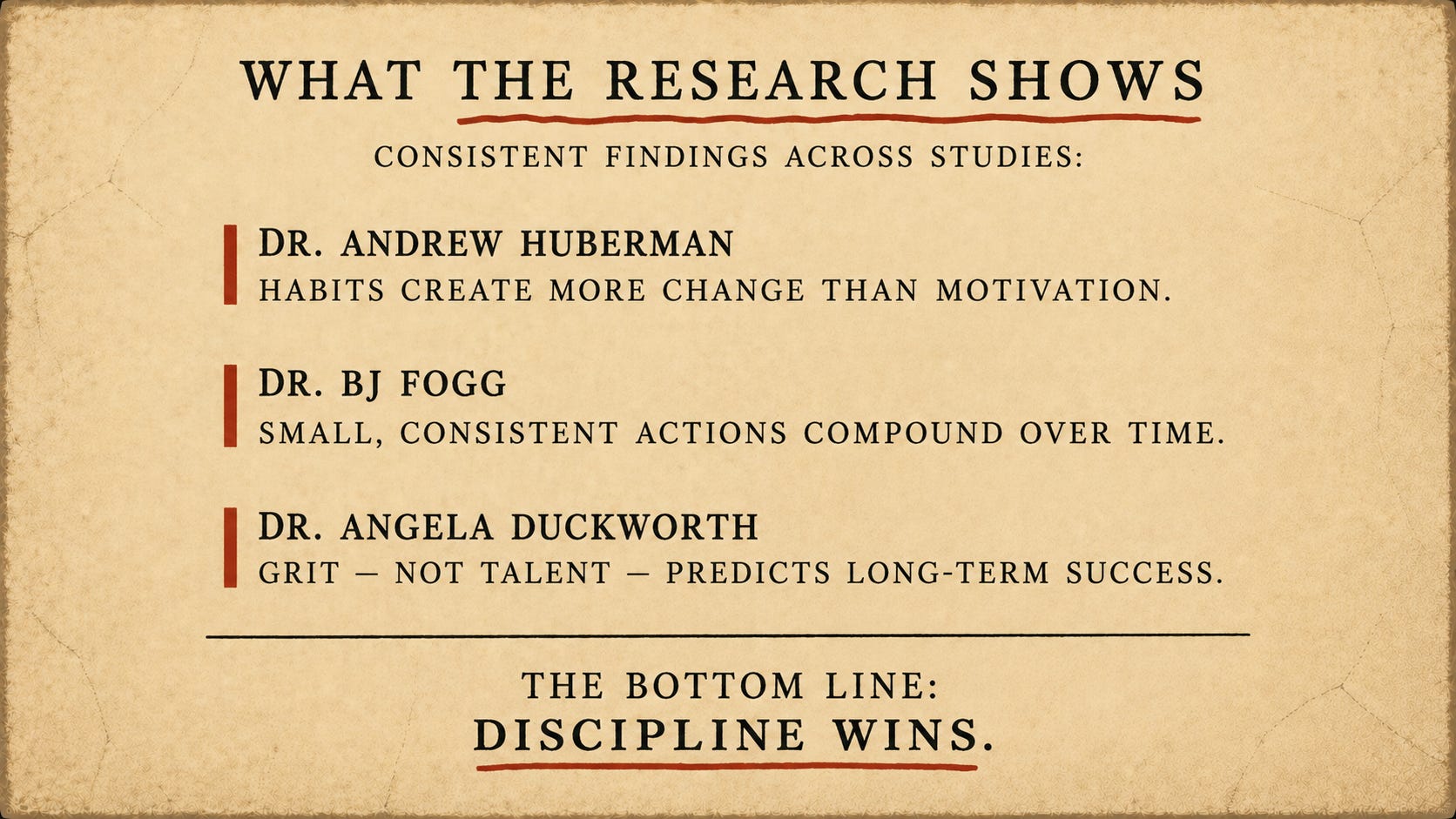
Grit provides more detail on an additional time dimension that is missing from both Baumeister’s and Mischel’s studies. When a new habit becomes repetitive and unexciting, but not yet automatic, there's no guidance on how to proceed if the day lacks significant positive or negative events. Grit helps to provide an answer in this case. After following people through this gap, Duckworth found that those who were the least gifted naturally also did not make it. They were the ones who maintained some level of standard on the boring days and on the days that were of great significance.
In Duckworth’s training program, it was surprisingly surprising to find that those who dropped out because of low physical fitness were not the weakest physically of the group. Many healthy people also quit. The success of the program was more about the consistency of effort than the amount in the beginning.
I think this is the part that most advice on discipline is missing, as people are more responsive to interesting information instead of boring information . There is no motivation to remind people that success will not happen at random. The answer for me for a longer period, I wanted to quit, was to make a promise to myself that each Tuesday would be the answer to my much bigger problem or problem of motivation.
I no longer value calling myself disciplined for the days I succeed. Now I simply have a daily checklist without excuses. My proof-of-record will come after it has been done, unlike in the past where I waited to call myself something before I earned it.
One Thing to Do Today
You guarantee a win if you change the circumstances you operate . Keep that promise by winning. Tell everyone you’ve made that promise to and give it your all to follow up.
This article is the first of many to address the finer details of the everyday application of discipline. The paid essays from The Deliberate Project do further research and describe the systems behind each one.
Have advice, a letter, or a suggestion for us? Send it to kanpoteau@gmail.com.
See you next time,
The Deliberate Project Team
References
1. Baumeister, Roy F., Ellen Bratslavsky, Mark Muraven, and Dianne M. Tice. “Ego Depletion: Is the Active Self a Limited Resource?” Journal of Personality and Social Psychology, 1998.
2. Mischel, Walter, Ebbe B. Ebbesen, and Antonette Raskoff Zeiss. “Cognitive and Attentional Mechanisms in Delay of Gratification.” Journal of Personality and Social Psychology, 1972.
3. Duckworth, Angela L., Christopher Peterson, Michael D. Matthews, and Dennis R. Kelly. “Grit: Perseverance and Passion for Long Term Goals.” Journal of Personality and Social Psychology, 2007.