

I noticed it standing in front of the pantry at nine at night, hand already on a bag of chips I had no genuine desire for. Nothing about the moment made sense. I had eaten dinner. I was not hungry. I had spent the entire day making careful, disciplined choices: a hard conversation I did not avoid, a workout I did not skip, an email I did not fire off in anger. And then, hours later, standing in my kitchen, I caved to something I did not even want.
For a long time, I interpreted that moment as a character flaw. A weakness that showed up specifically at night, as if some part of me only became undisciplined once the sun went down. It took finding Roy Baumeister’s research to understand what actually happened, and it had nothing to do with character.
Baumeister, working at Florida State University, built a body of research showing that self-discipline behaves less like a fixed trait and more like a muscle in use. Each act of restraint draws from the same limited pool. Resisting a comment in a meeting, staying focused through a boring task, choosing the harder right thing over the easier convenient thing, all of it draws from one shared resource, and that resource depletes. By evening, mine was simply empty. The chips were never really the problem. The problem was that I had already spent, hours earlier, whatever discipline it would have taken to walk past them.
This reframes something people rarely question. Habit formation, the whole industry built around building better routines, usually treats discipline as a constant, something you either have enough of or you do not. But if Baumeister is right, discipline is not constant at all. It is a resource with a shape, heavy in the morning, thin by night, and habits are not what create discipline. Habits discipline builds once it has enough left over to build with.
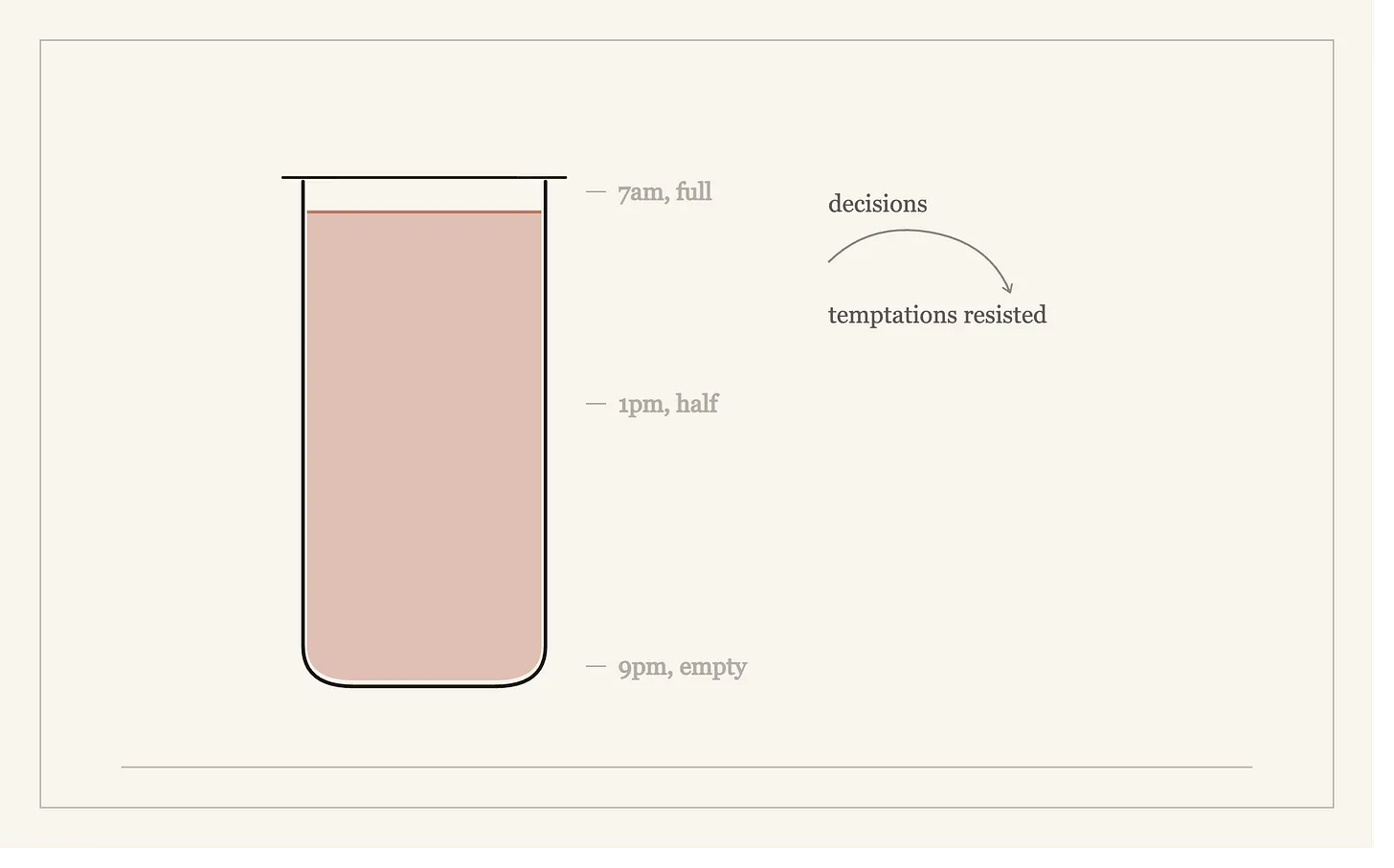
Kathleen Vohs, who has extended this line of research at the University of Minnesota, found something that made the picture even clearer. It is not just resisting temptation that drains the reservoir. Decision-making itself draws from the same pool. Every choice throughout a day, what to wear, how to respond to an email, whether to speak up or stay quiet, spends from the same limited account as resisting a late-night craving does. It’s the exhaustion from making many small choices.
Walter Mischel’s research offers the other half of the picture: not why discipline runs out, but what separates people who protect it well from people who do not. His research on delayed gratification, spanning decades, showed that the ability to wait for a better reward predicted long-term health, relationship, and achievement outcomes. But the detail people miss is how Mischel’s most successful subjects actually managed the wait. They were not white-knuckling through raw willpower. They distracted themselves by turning away, restructuring the moment to avoid directly confronting the temptation. They were protecting a limited resource rather than burning through it.
Put Baumeister, Vohs, and Mischel together, and a different picture of discipline emerges than the one most habit advice assumes. Discipline is not something you summon through more effort at the exact moment you need it most. It is something you protect earlier, structure around, and spend deliberately, the way a person with a fixed daily budget does not develop more money through sheer will at the register. They plan the spending before the store.
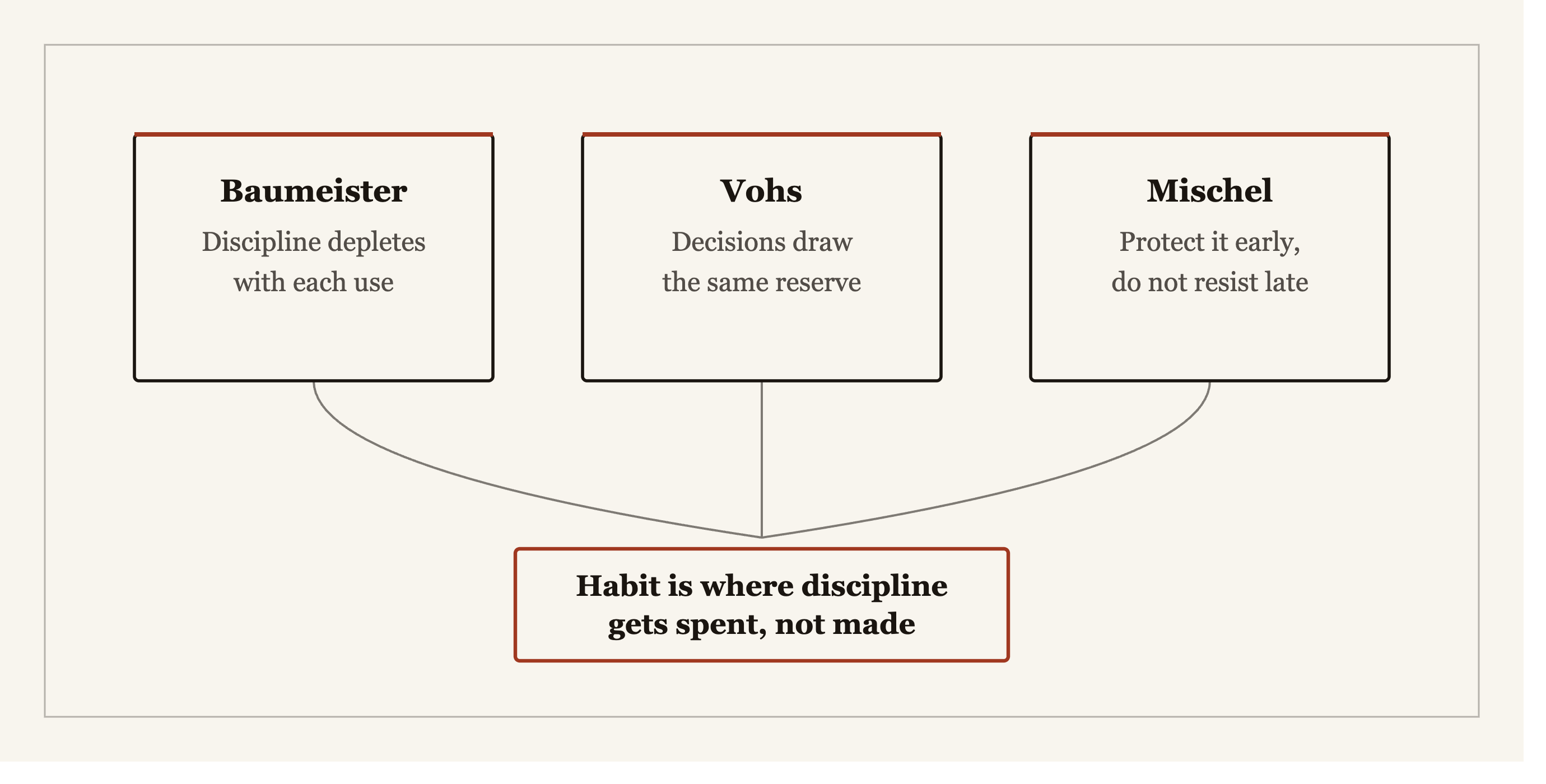
This is where habit actually enters the picture, not as the source of discipline but as its most efficient use. A habit, once built, requires almost none of the reservoir Baumeister described. Because the choice had already been made in advance, remaking it is unnecessary, which prevents the account from being drawn down each time. This is the real argument for building routines around the things that matter most. Not because habits make you disciplined, but because they are the one mechanism that lets discipline stop being spent on decisions it has already made.
The practical shift is smaller than it sounds. Instead of asking how to have more willpower, the better question is when your reservoir is actually full, and what deserves to be spent there first. For most people, that is the morning, before decisions have accumulated, before the day has drawn anything down yet. The hard conversation, the hard task, the choice you know you will want to avoid — these belong early, not late, not held for whenever you finally feel ready.
The One Thing to Do Today
Identify the one difficult thing you have been putting off until later today, and do it in the next hour instead. Your reservoir is fuller right now than it will be by evening.
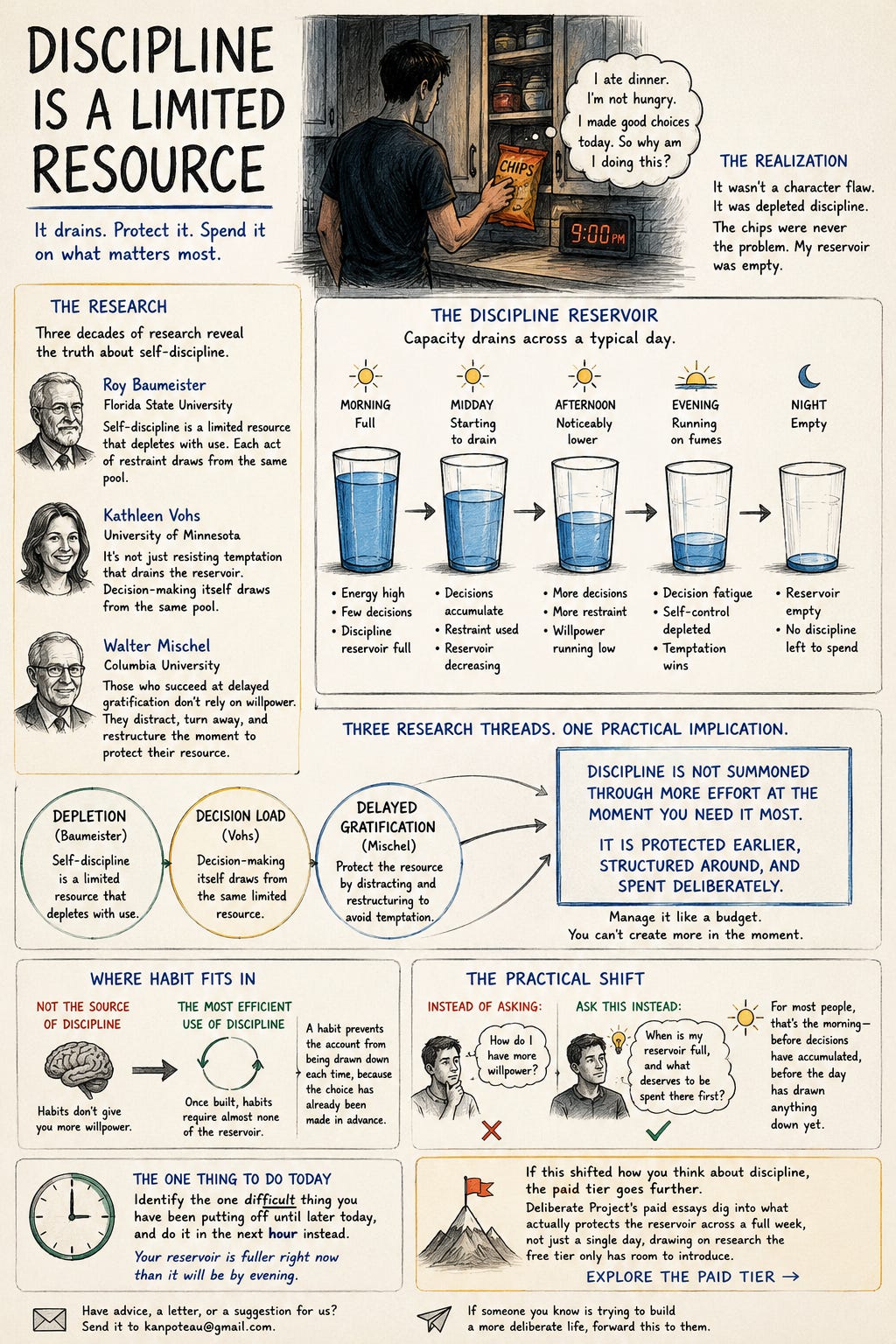
The discipline reservoir, showing capacity draining across a typical day.
If this shifted how you think about discipline, the paid tier goes further. Deliberate Project’s paid essays dig into what actually protects the reservoir over a full week, not just a single day, drawing on research the free tier only has room to introduce. Explore the paid tier →
Have advice, a letter, or a suggestion for us? Send it to kanpoteau@gmail.com.
If someone you know is trying to build a more deliberate life, forward this to them.
The Deliberate Project Team.
References
Baumeister, Roy F. Ego Depletion: Is the Active Self a Limited Resource? Journal of Personality and Social Psychology, 1998.
Vohs, Kathleen D., and Baumeister, Roy F. Understanding Self Regulation: An Introduction. Handbook of Self Regulation, 2004.
Mischel, Walter. The Marshmallow Test: Mastering Self Control. Little, Brown and Company, 2014.