


Two weeks before her presentation, Maya rehearsed the opening line in the mirror forty times. She timed her breathing. She studied the exact phrasing that other confident speakers used and practiced saying it the same way. None of it worked. The morning of the talk, her hands still shook while she waited backstage, and she wondered if some people were simply born with the calm she was chasing.
Confidence, it turns out, rarely shows up the way we expect it to. We treat it like a mood, something we either wake up with or wait for, and we assume that the people who walk into a room without flinching have access to some internal reserve the rest of us lack. The research tells a different story. Confidence is not a feeling that precedes action. It is a residue that an action leaves behind.
That distinction sounds small, but it changes everything about how a person should actually prepare for the moment that scares them.
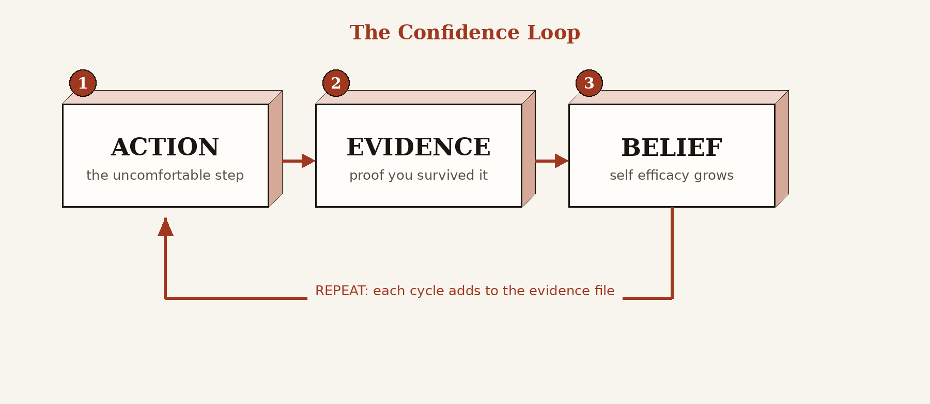
Action produces evidence. Evidence produces belief. Waiting reverses the order and stalls the loop.
The Personality Myth
It is tempting to sort people into two categories: the naturally confident and everyone else, and to treat the divide as fixed at birth. This framing is comforting strangely. It excuses the person who has not yet tried the hard thing, because if confidence is a trait rather than a skill, then not having it is simply bad luck rather than an unfinished project. It also flatters the person who already has it, since a trait feels earned by identity rather than by repetition.
The personality framing falls apart under closer inspection. Confidence rises and falls by domain within the same individual, which would not happen if it rode along with someone’s fixed temperament. A person can walk into a courtroom with total composure and freeze completely at a school pickup line full of parents she does not know. The same brain, the same personality, two wildly different levels of belief, because the two situations carry two entirely different evidence files.
Workplaces reveal this constantly. An engineer who argues her technical decisions with total conviction in a design review can go quiet and hedge every sentence the moment the conversation shifts to salary or promotion. Nothing about her intelligence or her nervous system changed between the two conversations. What changed is that she has a decade of proof behind her technical judgment and almost none behind her ability to advocate for her own compensation. Treat that gap as a skill deficit rather than a character flaw, and the fix stops being about willpower and starts being about deliberately collecting the missing evidence.
Confidence Is Downstream of Competence
Albert Bandura, the Stanford psychologist who spent four decades studying belief and behavior, called this self-efficacy. He found that confidence in a specific domain grows almost entirely from evidence, not encouragement. Watching someone else succeed helps a little. Hearing a coach say you can do it helps even less. What actually gets meaningful results is a memory of having done the hard thing yourself, even once, even imperfectly. Bandura called this a mastery experience, and of the four sources of self-efficacy he identified, it remained the strongest by a wide margin across decades of research.
This explains why confidence feels so unevenly distributed. Not that some people carry more courage in their nature. It is that some people have simply accumulated more proof. A surgeon feels calm in the operating room because she has stood at that table hundreds of times before, not because she was born composed. A new parent who feels shaky during the first diaper change and steady by the tenth has not changed as a person. She has changed her evidence file.
Every domain works the same way, whether the task is public speaking, negotiating a salary, or asking someone on a second date. The nervous system does not ask whether you deserve to feel ready. It only asks whether it has seen you survive something like this before.
Why the Quick Fixes Rarely Hold
A long list of shortcuts promises confidence without the work. Power poses before a meeting. Affirmations recited in a mirror. Visualization exercises meant to trick the brain into feeling ready. Some of these produce a small, temporary lift in mood. Almost none of them produce a lasting change in belief, because none of them add to the evidence file that self-efficacy actually runs on. A person can stand like a superhero for two minutes and still walk into the meeting with the same track record he had before he started posing.

The problem with borrowed confidence is that it collapses under actual pressure. The moment something goes wrong, the trick has nothing to fall back on. Genuine self-belief survives a stumble because it is built from a history of stumbles that did not end the story. Manufactured confidence survives nothing, because it was never anchored to anything real.
Confidence built on tricks collapses the moment something goes wrong. Confidence built on evidence has already survived worse.
Shortcuts persist in popular advice because they are easy to sell and easy to try. A two-minute pose or a morning affirmation costs almost nothing and can be attempted without changing a single habit or taking any actual risk. Building genuine self-efficacy costs more. It requires seeking the uncomfortable situation on purpose, tolerating the awkwardness of doing something poorly before doing it well, and repeating that process enough times for the evidence to accumulate. There is no version of this that skips the discomfort, which is precisely why the shortcuts remain so appealing and so unreliable at the same time.
The Trap of Waiting to Feel Ready
The instinct to wait until you feel ready is understandable, and it is also the exact mechanism that keeps people stuck. If confidence only arrives after evidence, and evidence only arrives after action, then waiting to feel confident before acting guarantees the feeling never comes. The sequence runs backward from how most people assume it works. Action produces evidence. Evidence produces belief. Belief was never supposed to come first.
Maya’s rehearsals in the mirror were not useless, but they aimed at the wrong target. She was trying to manufacture the feeling before doing the thing that actually produces it. The version of preparation that works is smaller and less comfortable. It means giving the talk in front of three colleagues before giving it in front of three hundred. It means sending the imperfect draft instead of polishing a fourth revision that nobody will read, anyway. Discomfort, not readiness, is the signal that the actual work has started.
This pattern shows up everywhere money and identity overlap. A freelancer waits to raise her rates until she feels confident enough to ask for more, but the feeling of deserving a higher rate almost always arrives after a client has already paid it, not before. A manager waits to feel like a leader before giving direct feedback, when the feeling of being a leader is largely built from the accumulated memory of having given that feedback and survived the discomfort of the conversation. Waiting for the internal state to catch up to the external role keeps the gap between them open indefinitely.
Small Wins Build Belief Faster Than Big Ones
In one of Bandura’s most cited studies, he worked with adults who were severely afraid of snakes, people who had avoided basements, gardens, and even certain aisles of the zoo for years. He did not ask them to conquer the fear all at once. He built a ladder of small, survivable steps. First watching him hold a snake from across the room. Then standing closer. Then, wearing gloves and touching one. Within a few hours of this graded exposure, most participants could do things with a live snake that they would have called impossible that same morning.

The detail that mattered most came later. Six months afterward, many of these same people reported feeling more confident in areas that had nothing to do with snakes. They spoke up more in meetings. They handled disagreements with more composure. Bandura called this the generalization effect, and it points to something important about how confidence actually spreads. It does not stay contained in the domain where it was built. Proof that you can handle one hard thing quietly rewires how capable you expect to be everywhere else.
Proof that you can handle one hard thing quietly rewires how capable you expect to be in every other room you walk into.
Therefore, the size of the first step matters less than whether it gets taken. A small, genuine success outperforms a large, imagined one every time, because the nervous system only trusts evidence it has actually collected.
Building a ladder like this for an ordinary goal takes less design than it sounds. Someone who wants to feel confident negotiating might start by asking for a small discount at a shop where the outcome barely matters, then move to asking a landlord for a minor repair, and then eventually negotiate a salary. Someone who wants to feel confident in social settings might start with a two-minute conversation at a coffee shop before attempting a room full of strangers at a conference. The domain stays the same while the stakes rise gradually, so each rung of the ladder is survivable, and survivable is the only requirement that matters. A step that feels completely safe adds too little evidence to count. A step that feels catastrophic adds too much risk to attempt. The right step sits in the narrow band between the two, uncomfortable enough to count as real, small enough to actually take.
What to Do With the Voice That Says You Are Not Ready
Kristin Neff, a researcher at the University of Texas who has spent her career studying self-compassion, found something that complicates the usual advice about confidence. People who treat themselves kindly after a setback, rather than harshly, hold higher self-confidence over time, not lower. This runs against the common assumption that self-criticism keeps standards high. Neff’s research found the opposite. Self-compassionate people aim just as high as anyone else. They simply do not fall apart when the aim misses, which means they get back up and try again sooner.
This matters because most confidence building happens on the far side of a failed attempt, not a successful one. A presentation that goes badly still adds to the evidence file, but only if the person survives the aftermath with enough composure to try a second time. Self-criticism turns each stumble into a reason to quit. Self-compassion turns it into information, a smaller and more useful thing to work with.
Consider two people who both bomb the same job interview. One spends the drive home replaying every wrong answer and privately deciding she is simply not cut out for interviews. She avoids applying again for months. The other notices the same mistakes, feels the same disappointment, and still tells herself that one unpleasant interview is a single data point rather than a verdict. She applied again the following week. Neither person felt confident walking out of that interview. Only one of them kept collecting the evidence that eventually would have made her confident, because only one of them treated the setback as survivable rather than disqualifying.
Confidence Is Not the Same as Certainty
One reason confidence feels so elusive is that people confuse it with certainty about the outcome. Real confidence does not require knowing that a plan will work. It requires trusting your own ability to handle whatever happens if it does not. The surgeon does not walk into every operation certain that nothing will go wrong. She walks in trusting that she has the training and the composure to respond well if something does. That distinction matters because it explains why confident people still feel fear. Fear is a response to uncertainty, and uncertainty never fully disappears. What changes with evidence is not the presence of fear but the size of the gap between the fear and your trust in yourself to move through it, anyway.
This reframing removes an unfair standard that keeps people stuck longer than they need to be. Nobody is asking you to eliminate doubt before you act. The goal was never to feel nothing. The goal is to build enough of a track record that doubt no longer gets the final vote.
Keep a Record of the Evidence
Most people never actually notice the evidence they are collecting, because the moments that build self-efficacy rarely feel significant while they are happening. The tough phone call was made and immediately forgotten. The awkward first attempt to get filed away as embarrassing rather than as proof. Without a deliberate record, the brain defaults to remembering failures more vividly than the small wins, which quietly convinces people they have less evidence than they actually do.
A simple habit corrects this. At the end of each week, write one thing you did that you would not have attempted a year ago. Not a grand accomplishment, just a specific instance of doing the uncomfortable thing, anyway. Over a few months, that list becomes a written record of the evidence file Bandura described, something concrete to point to on the days doubt gets loud. The habit costs two minutes. The effect compounds in a way that no affirmation ever will, because it is built from things that actually happened rather than things you told yourself to believe.
Where to Start This Week
None of this requires a personality change. It requires a slightly smaller task than the one making you hesitate, done today instead of rehearsed indefinitely. Pick the version of the hard thing that scares you a little less. Email before it feels perfect. Ask in the smaller meeting before asking it in the larger one. Confidence will not arrive to make that first step easier. It will arrive because you took it anyway, and it will still be there the next time you need it.
Confidence will not arrive to make the first step easier. It arrives because you took the step, anyway.
Maya gave her talk with shaking hands. Nobody in the room noticed. Three months later, she volunteered to give the next one, and this time her hands stayed still. The calm did not arrive early. It arrived on schedule, right after the evidence did.
References
Bandura, A. (1977). Self Efficacy: Toward a Unifying Theory of Behavioral Change. Psychological Review, 84(2), 191 to 215.
Bandura, A. (1997). Self Efficacy: The Exercise of Control. New York: W. H. Freeman.
Neff, K. D. (2023). Self Compassion: Theory, Method, Research, and Intervention. Annual Review of Psychology, 74, 193 to 218.